
Interview | Leslie Yip Boucher-Harris Text | Connie Li
Photography | Tom Ho, Courtesy of Vivienne Poy
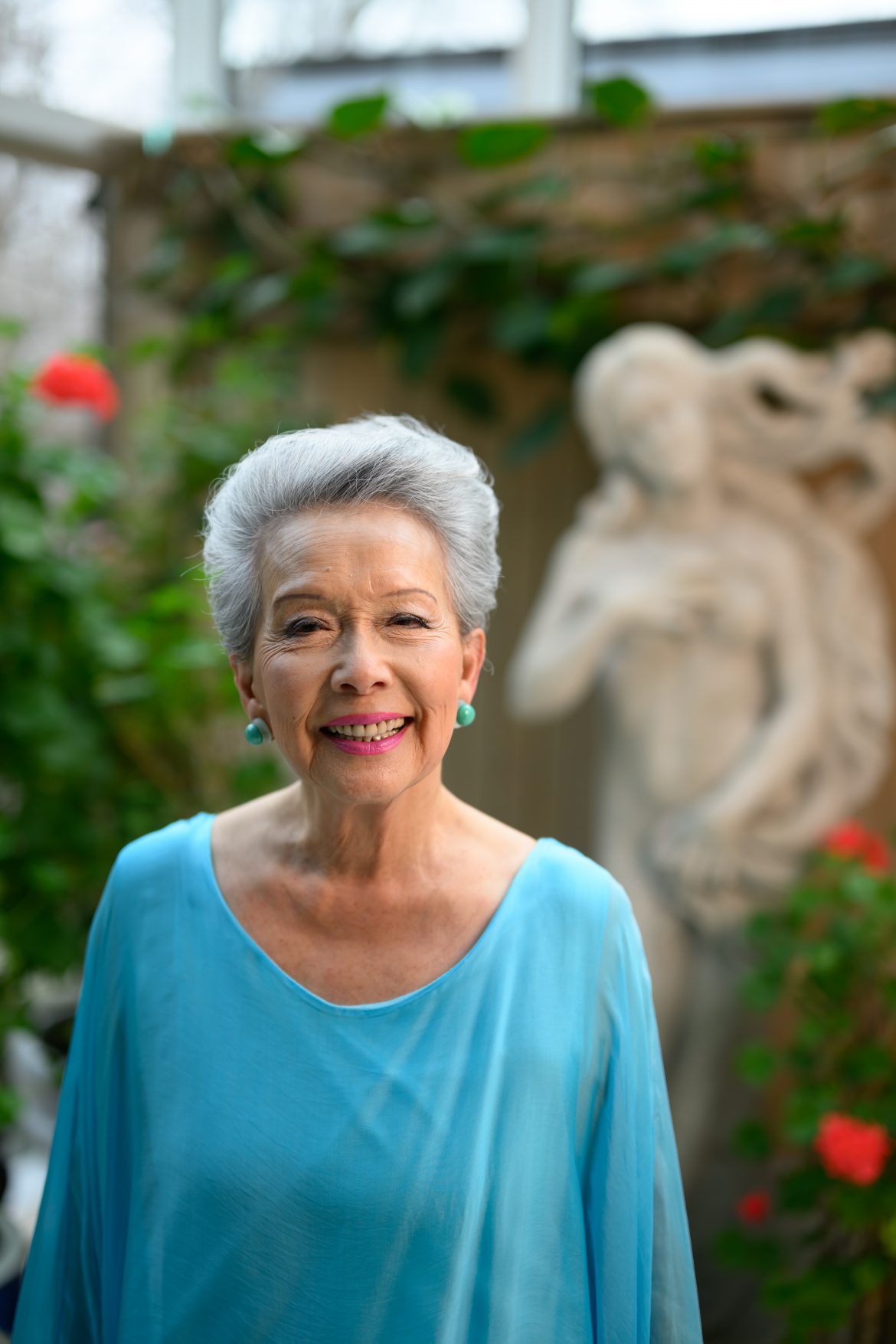
When we chose longevity as a key theme for our March issue, picking our cover star was effortless. The honourable Dr. Vivienne Poy—the first Asian Canadian appointed to the Senate of Canada—stood out immediately. Her public legacy is extraordinary, but what’s even more striking is the vitality, clarity and beauty she radiates at 85. It’s not about preserving youth; it’s about living fully and earning every bit of who she is.


I reached out to her with some nervous anticipation. Her response was immediate and warm, opening the door to a conversation that would move far beyond titles, honours and achievements.
Vivienne Poy’s résumé is impressive by any standard: she comes from Hong Kong’s renowned Lee Hysan family, earned a PhD in history from the University of Toronto, became its 31st Chancellor (and first of noncaucasian descent), served as a senator and is an entrepreneur, designer, author, public speaker and a historian. But when we sat down together, the conversation skipped over politics and accolades. Instead, she shared stories of her childhood, her marriage, what she’s learned, movement, colour, and flowers. It wasn’t a public figure I met, but a woman who’s genuinely comfortable with the life she’s built—and continues to enjoy.
That morning she wore a vivid coral-pink top, sitting against a wall of f lowers. Silver hair neatly styled, lipstick perfectly applied, her presence was radiant. Nothing about her suggested the conventional image of an octogenarian. If anything, her elegance and composure made even younger generations feel somewhat self-conscious by comparison.
Colour and the Courage to Begin
Surrounded by pinks, reds, and greens, our conversation naturally began with colour.
“I love colour. You can see that,” she said, smiling. “Especially red. I’ve always loved it. Growing up in Hong Kong, we wore red all the time— Chinese New Year, Christmas, everything was red.”
As a child, she wasn’t allowed to wear dark colours. “No black, no grey, no navy with the exception being her school uniform. Around Chinese New Year, we weren’t even allowed to wear white. It was very strict, very old-fashioned.”
Like many teenagers, she rebelled. “There were years when I absolutely refused to touch red. I went into very dull colours,” she laughed. “And then, gradually, I went back to colour. Now I wear reds that actually look very good on me.”

That love of colour found expression in her first entrepreneurial venture. In the early 1980s, she founded Vivienne Poy Mode, a knitwear brand known for its bold hues and exuberant textures. “The designs were very colourful and very joyful,” she recalled.
Recently, she received a message from someone who had been given one of her early designs years ago and still loves it—a shaggy, fur-like evening jacket.“I saw almost the exact same thing at Holt Renfrew, sold by a european designer at an exorbitant price!” She smiled. “I thought that was a lot of fun and I designed it 40 years ago!“
The brand began at home. She used a guest room as her studio, where she designed and produced pieces herself. A pivotal moment came from her father, with whom she was very close. “He said, ‘You can make beautiful things, high quality and fashionable—but unless people are willing to pay for it, it’s only a hobby.’ That really triggered something.”
So she tested the idea. She made appointments with highend boutiques downtown, showed her designs, took orders, and produced small batches. “That gave me confidence that it was wanted out there,” she said. “I learned everything from scratch. I was always around Spadina, the fashion district. That’s how I learned—how to deal with people, how things really work.”
Nature, Memory and A Shared Life
Despite her love of colour and fashion, Vivienne Poy speaks of nature with a kind of reverence that feels foundational. “People think of Hong Kong as crowded and full of buildings,” she said. “But when I was growing up, in the 1940s, it wasn’t like that. My best memories are of playing in our garden.”
When her father acquired their first boat, weekends were spent exploring the outlying islands, watching sunsets, and enjoying the beautiful scenes of the harbour. The family lived on Kennedy road, on the hillside, where birds were everywhere. Her father kept a canary on the balcony, attracting other birds. “I used to get up early just to listen to them,” she said. “Bird sounds calm me. Nature sounds calm me.”
Years later, she carried that habit with her. At their cottage, she would walk out of the house at four in the morning to record birdsong, quietly setting up before dawn. “I even played those recordings in my Senate office,” she said. “They were on tapes. When you can’t be outside, nature sounds still bring you there.”
Nature also became a common language in her marriage. Her husband, Dr. Neville Poy, retired from plastic surgery long ago and took up photography. Over the years, he quietly amassed an archive of images—people, animals, landscapes—mostly unseen. “
I didn’t want his photographs to just sit in the basement,” she said. “So I pushed.”
She would organize them, using her contacts, and soon came up with the concept for a book. He chose the images; she wrote the words and produced it. “He knows I know what I’m doing,” she says simply.

From Precious Moments

From Precious Moments
The result was Precious Moments, published in 2020. The book follows the seasons—but not in the usual order. “Most books start with spring and end with winter,” she explained. “I start with summer and end with spring. That’s my mindset. I don’t want to end in darkness or bleakness. Summer is colourful and lively. Spring is renewal. That’s how I see life.”

From Precious Moments
The lotus flower on the cover held special meaning. They had been planted years earlier in their bay in Muskoka, blooming every July. “We took so many photographs of them,” she said. “Then a few years ago, they disappeared. I’m so glad we have those images. They hold that moment.”

Their partnership, she stressed, has never been the cause of conflict. “We trust each other completely,” she said. “We each do what we’re good at.” This trust and freedom for each to pursue their own best course within a shared vision has been the hallmark, it seems, not only of their partnership, but their marriage.

From Precious Moments
“You have to give each other space,” she explained. “Encourage and support each other to do what you love to do. of equal importance,” she went on to say, “there has to be patience. There are always ups and downs, good times and not so good times,” she explained. “If you stay, if you work on the relationship with patience, trust me, you’re going to be in a much better space and you’re going to have a better relationship.” By this summer, Vivienne and Neville will have been married for 64 years.
Learning, Movement and Refusing to Stop
Throughout our hour-long conversation, her clarity never wavered. The secret, she said, is learning—constantly.
“I always want to learn something new every day,” she said. A recent example involved losing her car’s remote control on her phone while at their cottage in Muskoka. “It was cold, and I wanted to be able to warm the car up before going outside.” She called the dealer, followed instructions step by step, scanned QR codes, took photos of screens, troubleshooting until it finally worked. “I was outside in the car from eight until nine-thirty at night. But we did it. I was so pleased.”
“I have to learn everything from scratch, even at my age. That’s just the way I am , and I never give up.”
She applies the same discipline to her body. Despite severe arthritis, her flexibility surprises even her doctors and physiotherapists. “I don’t run. I don’t go to the gym. I never have time,” she said. “But I stretch every day—upper body in the morning, lower body at night. And I walk. I keep moving.”
Pain, she insists, is not an excuse. “If I’m in pain, I move slower. But I never stop.”
Balance is a daily practice. She stands on one leg “like a flamingo,” timing herself. Two years ago, she reached 70 seconds. “For anyone over 80, if you can do 30 seconds, you’re already amazing,” she said proudly.
She also walks backwards around her kitchen island—carefully, making sure the floor is clear.“It’s good for the brain,” she explained. “Your body knows how to balance; you don’t need to see. I am constantly training my brain.”

Even walking, she noted, requires attention. “A lot of older people look down and curve their posture. You’re not supposed to look at the ground. You look about ten feet ahead. You stand up straight. That’s how you avoid falling.”
Retirement, Contribution and the Meaning of Longevity
Vivienne Poy retired from the Senate at 71, four years earlier than required. “I had missed too many important family events,” she said. “As long as I’m still young enough to do things, I want the time to do them.”
Yet her retirement has not served to slow her down. In fact, it has only increased her involvement. “I like people. I like connecting,” she said. “A Social life is very important and I am fortunate to have friends everywhere. Now I don’t represent the government, I only represent myself and that flexibility is wonderful.”

Vivienne Poy shares the milestone moment—her appointment to the Canadian Senate—with her family.
When she was first appointed to the Senate in 1998, she was told she had made history. The moment prompted a deeper question. “Asians have been in Canada for a few hundred years,” she recalled. “Why was it only now that history was being made?”
That reflection led to concrete action, including her role in establishing Asian Heritage Month in Canada. “People say I did it for the Chinese community. No—I did it for all Asian Canadians,” she said.
“There is a sense of accomplishment when you help other people. People appreciate it and they remember you. That fuels my life. It makes me feel my life is worthwhile.”
I asked her how long she hopes to live.
“As long as I’m able to do everything I want to do,” she said without hesitation. “To me, long life means a meaningful life. I want to travel, to learn, to be with people. I don’t mean just physically surrounded by people, but actually interacting with them. I don’t want to just sit there and turn into a vegetable.”
A Life Still in Bloom
Toward the end of our talk, she began to reminisce about an experience she had when she was 18 and freshly arrived at Mcgill University. She had unexpectedly been nominated as a candidate for the election of Winter Carnival Queen despite knowing little of what it entailed. Her appetite for fresh challenges prevailed. She became one of f ive princesses that winter, and was crowned Queen in front of crowds and cameras at the Montreal forum, wearing a borrowed white evening gown.

At 18, Vivienne Poy was crowned Queen of the McGill Winter Carnival by the Chancellor of the University.
Decades later, the memory still made her smile.
Looking at Vivienne Poy then—animated, thoughtful, quietly amused—it was impossible not to see continuity. The young woman who once stepped into the unknown is still here. Decades have added experience and wisdom, but they have not diminished her sharpness, her vitality, or her beauty.
Perhaps this is where the true meaning of longevity resides—in a life that remains engaged, purposeful and deeply worth living.
