
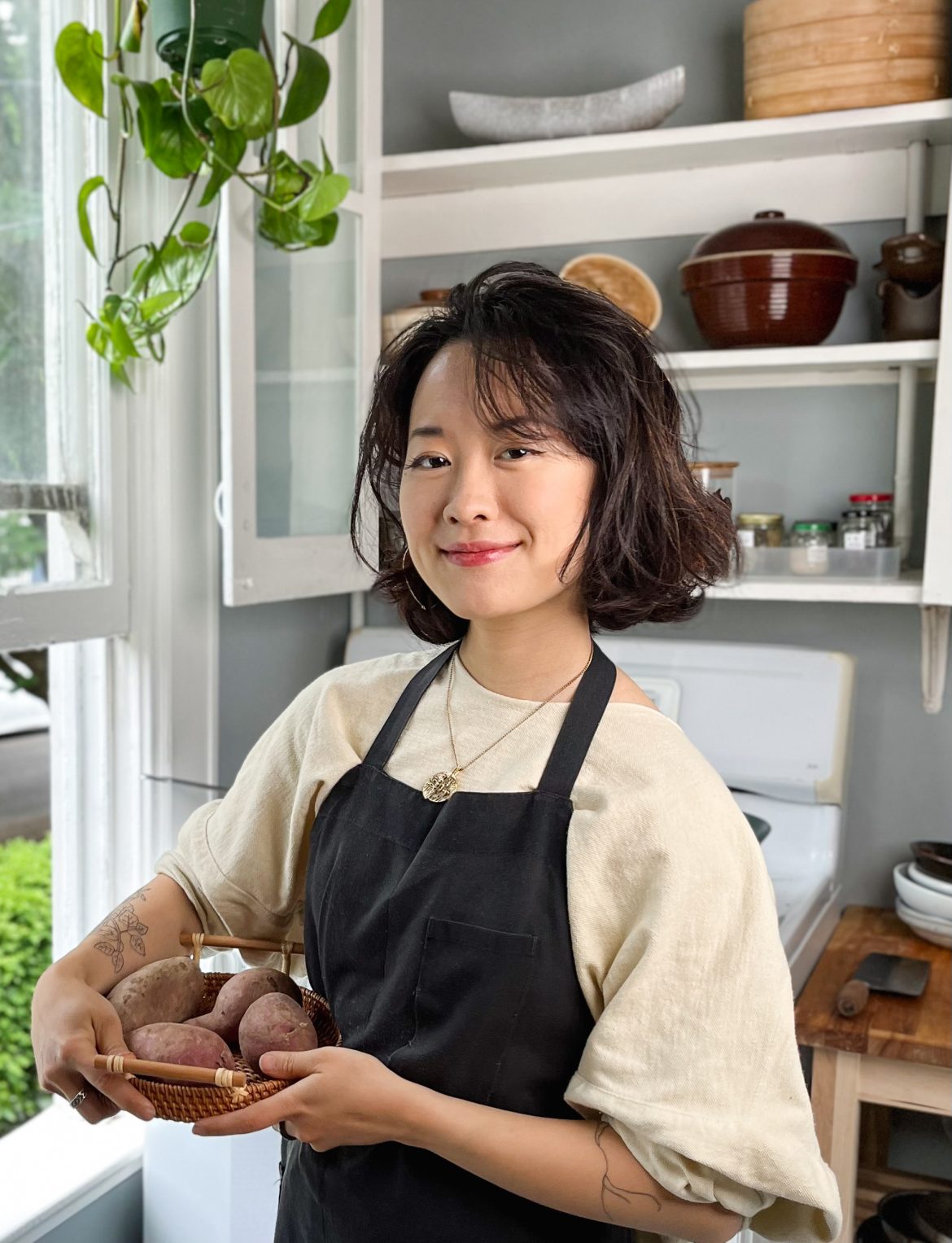
Congratulations to Hannah Che, our cover girl in this year’s January/February issue, on her nomination for a James Beard Award for her cookbook The Vegan Chinese Kitchen.
To celebrate this honour, we are reposting her story so everyone can read about her great culinary journey again.

Story | Connie Li Photography | Hannah Che, Kenneth Edwards, Ruta Kuzmickas
Stir-fried diced choy sum & tofu, stir-fried cucumber with beech mushrooms, frozen tofu & sour napa cabbage, stewed vegetarian fish in sweet & sour sauce, mala-spiced gluten skewers, multigrain purple rice, scallion oil noodles…. Salivating yet? Undoubtedly you will be once you get your hands on The Vegan Chinese Kitchen, a 320-page cookbook that includes the aforementioned dishes among its 100+vegan recipes.

The Penguin Random House publication weaves together descriptions of special sources with cooking methods, the heritage of vegetarianism and family stories. But the woman behind this book is not your typical cookbook author. Hannah Che is a pianist who spent six years earning her Masters of Music and Bachelor of Music with Distinction from the Shepherd School of Music at Houston’s Rice University.
So, you might be wondering what prompted the Michigan-born musician to make the quantum leap from keyboard to spatula, from the works of Chopin to the cacophony of pots and pans? “Leaving music to become a chef was never a conscious, onemoment decision,” she says. “It just kind of happened as I followed opportunities.”

While training as a pianist, she developed a passion for food and started a food blog. Its popularity grew to the point where she was offered a cookbook deal six months after graduation. Later came the decision to become a chef.
There were hints of her parents’ influence at every step along the way. Her parents moved to Ann Arbor, Michigan in the 1990s from Harbin, in the northeast Chinese province of Heilongjiang. When she was 9, her father’s posting took the family to Shenzhen, China, and they returned to the US three years later. That helps explain why she is quite familiar with Chinese culture.

She recalls that her mom took her favourite wok with her, wherever home was, and would transform any food ingredients from the fridge into delightful meals, fragranced with oil, ginger, garlic, scallions and condiments.
Her father, originally from Shandong, loves to make steamed bread, and would find any excuse to start a big batch of yeasted dough to make comfort food, like scallion flower buns, baozi or dumplings. These were tasty morsels and one of her most joyful memories.
All along, the family diet included meat and vegetarian choices, but in 2015, she decided to go vegan after being shocked by off-putting stories about the animal agriculture industry and how meat, dairy and eggs were produced, plus the environmental damage caused by factory farming.
After going vegan, Che began to cook for herself when meat was served on the family dinner table. Over time, her family adopted her vegan diet, too.

She began to collect vegan recipes and found that, while there was no shortage of recipes of western vegan and salad dishes, there were very few for Chinese dishes. So, she felt her way forward was to create her own recipes. In order to research and learn more about Chinese vegetarian food, she attended the Guangzhou Vegetarian Culinary School for two years after graduating from the music conservatory.
“I learned the long history behind Chinese vegetarian traditions, like temple cooking, palace cooking and popular vegetarianism, each of which was developed over thousands of years,” says Che. “I also look up to the chefs who are developing modern dishes and opening new vegan restaurants in cities like Shanghai, Guangzhou, Beijing, Dali and even Harbin.”
These inspired and cemented her confidence and desire to write a cookbook of Chinese vegetarian food. “Many people are interested in Chinese cooking, and eating less meat for health reasons,” says Che. “Vegan cooking is both delicious and easy to learn. Ingredients like tofu, Sichuan peppercorns and oyster sauce are mainstream now, so why not tofu skin, tofu sheets, preserved black beans or Chinkiang vinegar?”

Growing up with “dongbei” (northeastern Chinese) cooking was her introduction to vegetarian food. Home-cooked favourites, like stewed beans and potato, frozen tofu and sour nappa cabbage stew, are all-time favourites for her.
“People have a misconception that Chinese food is oily, laden with sodium or unhealthy because they’ve only experienced food in restaurants. Obviously, home cooking is very different.”

Che thinks Chinese flat cabbage or eggplants are just more delicious than their western counterparts, and she feels more nourished with fivegrain rice or congee, pan-fried tofu, steamed dishes or clay pot stews, with lots of fermented and pickled vegetables, than smoothies and western grain bowls and salads.
The Vegan Chinese Kitchen cookbook is a natural result of her love affair with home-style vegetarian cooking. She says she wanted to include personal anecdotes in the book. So unlike most Chinese cookbooks that typically group dishes according to the eight major regional Chinese cuisines, she used personal vignettes and stories, mixing Chinese text with English, to narrate the history and traditions of Chinese vegetarianism, and explain the common ingredients and condiments used in Chinese cooking.

She groups recipes by ingredients, and offers a variety of cooking techniques that can be used with each one, illustrated with quality photos to make them even more enticing.
“Dividing the book by ingredients allowed me to go in depth into each category of vegetable and plant protein, like tofu and tofu skin, and offer a variety of Chinese cooking techniques you could use for each one. The vegetable chapters move from spring to summer to fall to winter, highlighting the seasonality of the cuisine. I wanted the book to be a useful resource in the kitchen.”
It took three years from start to publication—to conduct her research, study recipes, cook the dishes, write the content, edit and take photographs. The journey had every bittersweet taste as her cooking. “Writing a cookbook is an intensely lonely process, which authors don’t really talk about. Many nights I’d be cleaning up my kitchen after a whole day of cooking, exhausted and feeling like there would never be an end.”
When she decided to be a chef, her mom described her move as “fierce.” “I don’t regret any decision I’ve made,” says Che. “I’m an impulsive person and very optimistic. I rarely pause long enough to reflect on my decisions or doubt myself.”
Che recently began studying the concepts of traditional Chinese medicine (TCM) and food therapy, and has set up a vegan restaurant in Portland, Oregon called Surong, serving modern vegan Chinese cuisine infused with TCM concepts.
She plans to return to China to do more research on tofu and fermented ingredients for a future cookbook.
For the many people making resolutions to eat healthier as 2023 dawns, Che suggests a tofu dish she learned in Guaugzhou. Here’s how it’s made:

* dice the tofu, blanch in salted water for about five minutes and drain.
* mix with chopped cilantro and scallion, or replace with basil or Chinese toon.
* drizzle with a few drops of sesame oil to finish the simple, delicious and healthy dish.
She also recommends a few refreshing and auspicious vegetarian dishes that are easy to replicate for sharing over family reunion dinners, or in joyful celebrations of the Chinese New Year.
FOUR DELIGHTS (SERVES 6)
7 grams dried wood ear mushrooms; ¼ cup raw peanuts; 4 dried shiitake mushrooms; 10 to 12 dried daylily flowers; 280 grams raised gluten cut into 1-inch cubes; 4 or 5 thin slices unpeeled fresh ginger; 2 scallions cut into 1-inch pieces; 1 star anise pod; 3 tablespoons soy sauce; 1 teaspoon dark soy sauce; 1 ½ cups boiling water; 2 tablespoons Shaoxing wine; 2 tablespoons rock sugar or Chinese brown sugar; ½ teaspoon salt; ½ teaspoon toasted sesame oil.

One hour before cooking, soak the wood ears and peanuts in a small bowl of boiling water. Soak the shiitake mushrooms and daylily flowers in another bowl with at least 1½ cups boiling water (you will reserve this liquid).
Heat about 2 inches of vegetable oil in a wok over medium heat to 360°F (180°C). Fry the gluten cubes in batches until they are golden and crisp on the edges, about 3 minutes. Remove and drain on a paper towel–lined plate, reserve 2 teaspoons of oil in the wok.
Squeeze out the water from the shiitake mushrooms and daylily flowers. Trim off and discard the mushroom stems, and cut the caps into 2 or 3 pieces each.
Tear the soaked wood ears into bite-size pieces, discarding any knobby ends.
Return the wok to medium-high heat. Add the ginger and scallions and stir-fry briefly to release their fragrance, then add the wood ear and shiitake mushrooms. Stir-fry for 2 minutes, until the mushrooms start to brown, then add the star anise, both types of soy sauce, the Shaoxing wine, sugar, and 1½ cups of the reserved mushroom soaking liquid.
Bring to a boil, add the fried gluten and drained peanuts, and lower the heat to maintain a simmer. Cover and cook for about 15 minutes, until the gluten is soft and soaked with flavour. There will seem to be too much liquid at first, but it will gradually be absorbed.
Add the daylily flowers. Turn the heat to high and cook until the liquid is reduced to a depth of ½ inch and starts to thicken into a glossy sauce, 8 to 10 more minutes. Sample and add salt to taste.
Stir in the sesame oil and remove from the heat. Serve immediately, or let cool and serve at room temperature or chilled.
PEA SHOOTS IN SILKY SOUP (SERVES 5)
224 grams pea shoots or bunched spinach; 1 tablespoon goji berries (for colour; optional); ¼ cup all-purpose flour; 2 tablespoons toasted sesame oil; 5 cups light vegetable stock or water; ½ teaspoon salt; 56 grams fresh shiitake mushrooms, stemmed and thinly sliced.

Keep the leaves and crisp stems of the pea shoots and pluck off any hard tendrils and stems. Soak the goji berries (if using) in cool water to plump.
Bring a pot of water to a boil and blanch the pea shoots until just wilted, about 20 seconds. Drain in a colander and shake dry.
Heat a dry wok over low heat. Add the flour and toast, stirring continuously, until pale yellow and faintly fragrant, about 1 minute.
Stir in the sesame oil to form a smooth paste and cook, stirring continuously for 2 to 3 minute until the mixture is golden in colour.
Add the stock and raise the heat to medium. Stir the soup continuously from the bottom until the mixture reaches a gentle boil and skim off any foam that rises to the top. The soup should look
creamy. Season with salt.
Add the mushrooms, reduce the heat to low, and simmer for 3 minutes to cook through. Add the blanched pea shoots and cook for about 2 minutes to heat them through.
Transfer to a large soup tureen or ladle into bowls. Garnish with a few goji berries, if desired, and serve immediately.
