
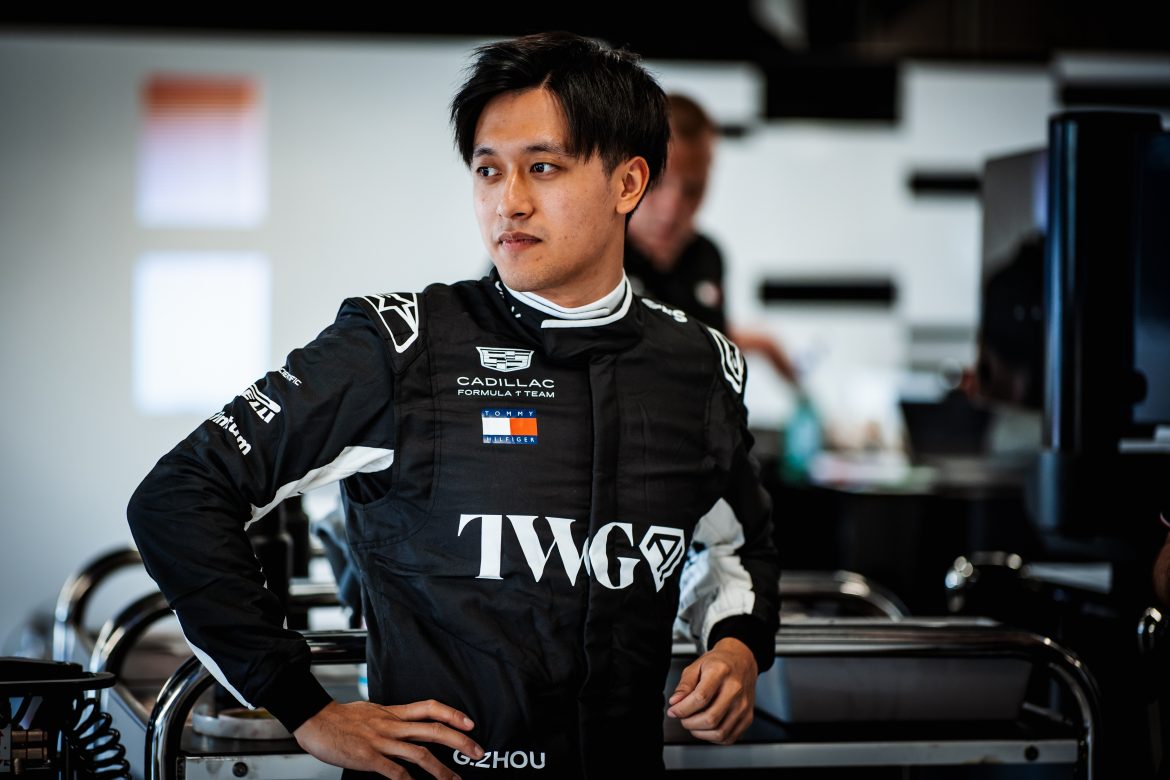
Interview | Leslie Yip Text | Connie Li, Leslie Yip Photography | Courtesy of Zhou Guanyu, Cadillac
The Cadillac garage was calmer than television would have you believe.
During the Canadian Grand Prix weekend in Montreal, mechanics rehearsed tire changes with choreographed precision while engineers studied air temperature, track temperature and performance data with quiet focus. Guests moved past the garage taking photos and videos, yet the team remained absorbed in its work. No one looked distracted. No one appeared rushed.

Formula 1 is often sold through noise and drama, but up close, its power lies in control. The tire guns were loud enough to startle, and the engines still roared through the Loop earplugs provided to guests. But amid all that intensity, there was an astonishing calm.

A few days later, that impression came back during a video interview with Zhou Guanyu.
At 27, Zhou still looks youthful, but he carries a grounded energy. He speaks thoughtfully, smiles easily and answers without the guarded stiffness that can sometimes come with elite athletes.

Zhou Guanyu (CHN) Cadillac Formula 1 Team Reserve Driver on the grid.
14.03.2026. Formula 1 World Championship, Rd 2, Chinese Grand Prix, Shanghai, China, Sprint and Qualifying Day.

Zhou Guanyu (CHN) Cadillac Formula 1 Team Reserve Driver on the grid.
14.03.2026. Formula 1 World Championship, Rd 2, Chinese Grand Prix, Shanghai, China, Sprint and Qualifying Day.
As China’s first—and still only—Formula 1 driver, Zhou has spent much of his career carrying a significance larger than himself. He made his F1 debut in 2022 with Alfa Romeo and continued with the Sauber-run outfit through 2024. He later became a reserve driver for Scuderia Ferrari, and today is part of Cadillac’s first Formula 1 season as reserve driver, working alongside race drivers Valtteri Bottas— his former Sauber teammate—and Sergio “Checo” Pérez.

THE DREAM
Zhou’s love of Formula 1 began in the grandstand.
“When I was about six years old, I had the chance to attend the first Chinese Grand Prix in 2004,” he says. It was the V10 era, when Formula 1 engines produced a scream that still lives vividly in the memories of those who heard it in person.
“I fell in love with racing, with Formula 1, with motorsport,” he beams. “The noise was insane. I didn’t just want to become a racing driver. I wanted to become a Formula 1 driver.”
He began karting at eight and quickly became one of the top young drivers in China. But success at home was only the beginning. To reach Formula 1, he knew he would have to prove himself internationally.

Claimed victory in a round of the 2013 British Kart Championship.


At the 2013 Super One Series annual awards ceremony.
“By winning every race in China, it doesn’t automatically make you attractive to any team in europe or to F1 academies,” he explains. “You have to win internationally. You have to beat the best young drivers from europe and around the world. Then maybe the doors open.”
Moving abroad meant leaving behind family, friends and everything familiar. It meant adapting to a new culture, competing against the strongest young drivers in europe and starting again from zero.
“That was the difficult part,” he says. “You have to show results. You have to show improvement every year.”
The results came. Zhou joined the Ferrari Driver Academy as a teenager, later became part of the Renault programme and eventually reached the Formula 1 grid. For Chinese fans, his arrival represented more than one driver earning a seat. It changed the way many people in China saw the sport.
For years, Chinese Grand Prix tickets were often distributed through sponsors and partners. When he finally raced at home as a Formula 1 driver, demand looked very different.

Zhou Guanyu (CHN) Cadillac Formula 1 Team Reserve Driver with fans.
06.03.2026. Formula 1 World Championship, Rd 1, Australian Grand Prix, Albert Park, Melbourne, Australia, Practice Day.

Zhou Guanyu (CHN) Cadillac Formula 1 Team Reserve Driver on the FanZone Stage.
14.03.2026. Formula 1 World Championship, Rd 2, Chinese Grand Prix, Shanghai, China, Sprint and Qualifying Day.
His own grandstand sold out within minutes.
Zhou remembers being at dinner when ticket sales opened. Soon, his phone was filling with messages from people asking whether he had access to more seats.
“The whole track was gone in 20 minutes,” he says, still sounding slightly amazed. “I wasn’t expecting that. You know you are doing what you love, but you don’t know what difference it is going to make for the country. The fan base just keeps growing, and I’m really grateful for that.”
THE COST
The danger of Formula 1 is obvious. Zhou knows it intimately. At the 2022 British Grand Prix at Silverstone, his car flipped upside down and travelled at terrifying speed toward the barriers and catch fencing.
“It was crazy,” he says. “That was probably the most scared I have ever been in a race car.”
The car’s halo protection system played a crucial role in his survival. Zhou is clear about his gratitude for modern Formula 1 safety, but he is equally clear that a professional driver cannot afford to live inside fear.
“I was very lucky to still be here,” he says. “Afterwards, I tried not to watch the videos or look at the pictures from that day. I had another race the following week, so I had to get it out of my mind very quickly.”
Off track, however, Zhou avoids unnecessary risk. He enjoys sports, but not extreme ones. No skydiving, no thrill-seeking. In fact, he admits with a laugh that he is scared of heights.
“I can take flights, that’s fine,” he says. “But I try to stay as safe as possible outside racing.”
Inside the car, danger becomes part of the discipline. So does frustration. When mechanical problems arise, when strategy fails, when another driver makes contact or when a race slips away, the driver is the most visible figure—but far from the only person affected.


“Formula 1 is a team sport,” Zhou says. “In a top team, you can have more than a thousand people working for two drivers. even in an average team, there are more than 500 people working on your car. You have to have huge respect for them.”
THE DISCIPLINE
Even eating becomes part of performance.
On a standard race weekend, Zhou wakes around 8:30 or 9 a.m. and arrives at the track by around 10 or 10:30, hours before the first practice session. The time is filled with engineering meetings, preparation and data analysis. Meals are fitted around the schedule, not the other way around.
“We don’t really have time to eat lunch at the hospitality,” he says. “After FP1, we eat straight away, then we look at the data. You don’t want to waste time on food.”
His race-weekend meals are almost surprisingly plain. on Fridays and Saturdays, lunch might be a small slice of bread and a few thin slices of lean meat.
“No sauce,” he says. “Just a little salt. everything is very dry.”
Before Sunday’s race, the most physically demanding day of the weekend, he may eat something heavier. even then, it might simply be plain white rice.
“You want to keep your stomach clean,” he explains. “You don’t want to be vomiting. That’s the last thing you want when driving these cars.”
He tries to eat the same things throughout the season so his body knows exactly what to expect. Taste is beside the point.
“It’s pretty boring,” he says. “But you do it for the body, not for the taste.”
It is a small detail, but a revealing one. Formula 1 may surround itself with champagne, luxury suites and global glamour, yet inside the cockpit, success often depends on restraint. For Zhou, discipline is not a slogan. It is daily practice.
THe DESIGNER
Then the conversation turns to style, and Zhou becomes visibly more animated.
Formula 1 and fashion have grown increasingly close in recent years, but for Zhou, design is not merely about image. It is one of the few areas in a driver’s life where personal expression remains possible.
At the track, the team kit is fixed. Race suits follow strict requirements. But the helmet is different.
“I’m a pretty good designer, I have to say,” he says, laughing.
Most of his helmet ideas begin with him. He sketches concepts on his phone or on paper, then sends the overall direction to a designer who develops the final details and integrates the sponsor requirements.
“With the helmet, you have decisions you can make—the colours, the inspiration, the whole design,” he says.
Two helmets remain especially meaningful.
The first was for his home race in Shanghai. Zhou knew many drivers would instinctively choose red or dragon motifs for a China-themed design. He wanted something more personal and less expected. His inspiration was the Shanghai subway map. each line has its own colour, forming a visual language instantly recognizable to anyone who knows the city. on a helmet, the idea became graphic, subtle and deeply personal.


 “It represented me and the city,” he says.
The second was a Japanese Grand Prix helmet created with Hiroshi Fujiwara, the influential designer behind fragment design.

One of Zhou Guanyu’s favourite helmets is the special design created by Japanese streetwear pioneer Hiroshi Fujiwara for the Japanese Grand Prix. It features Fujiwara’s signature double lightning bolt motif and classic houndstooth pattern, along with the inscription “1:44.411 / 2022”—commemorating Zhou’s fastest lap of the 2022 Japanese Grand Prix at Suzuka.

“He’s one of my dream designers,” Zhou says. “To have the chance to let him design a helmet for me, that was very special.”
Away from the track, he plays padel and games when time allows. Counter-Strike is a favourite. In China, where visits are shorter but emotionally important, he prefers to spend time with friends, playing football, basketball and tennis.
Still, design keeps returning as a thread. In the helmets, in the fashion references, in the desire to do something original, Zhou seems drawn not only to speed but to self-expression.
THE FUTURE
As Cadillac’s reserve driver, Zhou’s role is to stay ready while contributing to the team’s development. It is not the same as holding a race seat, but there is no bitterness in the way he speaks about his path. Having been on the grid, then moving through reserve roles with Ferrari and Cadillac, he remains focused on the next opportunity.

His ultimate goal is still to race in Formula 1 again.
At the same time, his ambitions reach beyond his own career. As the first Chinese driver to compete in Formula 1, Zhou understands how difficult the road has been. He hopes future drivers will not have to follow such a lonely path.
“When I’m older, when I retire from racing, I want to give young drivers more chances to chase their dreams,” he says. “To make their journey not as difficult as mine.”
Near the end of our scheduled interview, with time for just one final question, I ask Zhou what he might have become if Formula 1 had never entered his life.
“Fashion designer.”
The answer comes quickly, but it does not feel casual.
“I’m very interested in designing things,” he says. “I want to be different from other people. If I design something, I don’t want to copy anyone. I want to have my own inspiration.”

It makes sense. The Shanghai subway helmet. The Hiroshi Fujiwara collaboration. The instinct to avoid the obvious. The refusal to simply follow the expected line.
When I suggest that perhaps one day our magazine might feature one of his designs, Zhou looks genuinely excited.
Perhaps that is what makes him so compelling. Zhou Guanyu has already done something few imagined possible: leaving Shanghai, reaching one of the most exclusive sports in the world, becoming China’s first Formula 1 driver and continuing forward through every twist in the road. Yet he carries it all with ambition without arrogance, creativity without ego and resilience without complaint.
In Formula 1, the fastest route is rarely the most obvious one. Zhou seems to understand that better than most. He is still chasing speed, still chasing a return to the grid, still chasing the dream that began in a Shanghai grandstand more than two decades ago. But beyond the racing line, another story is taking shape—that of a young man from Shanghai quietly breaking barriers on one of the world’s biggest stages, with the precision of a driver and the imagination of a designer.
