
Story | Leslie Yip Photography | Louis Vuitton
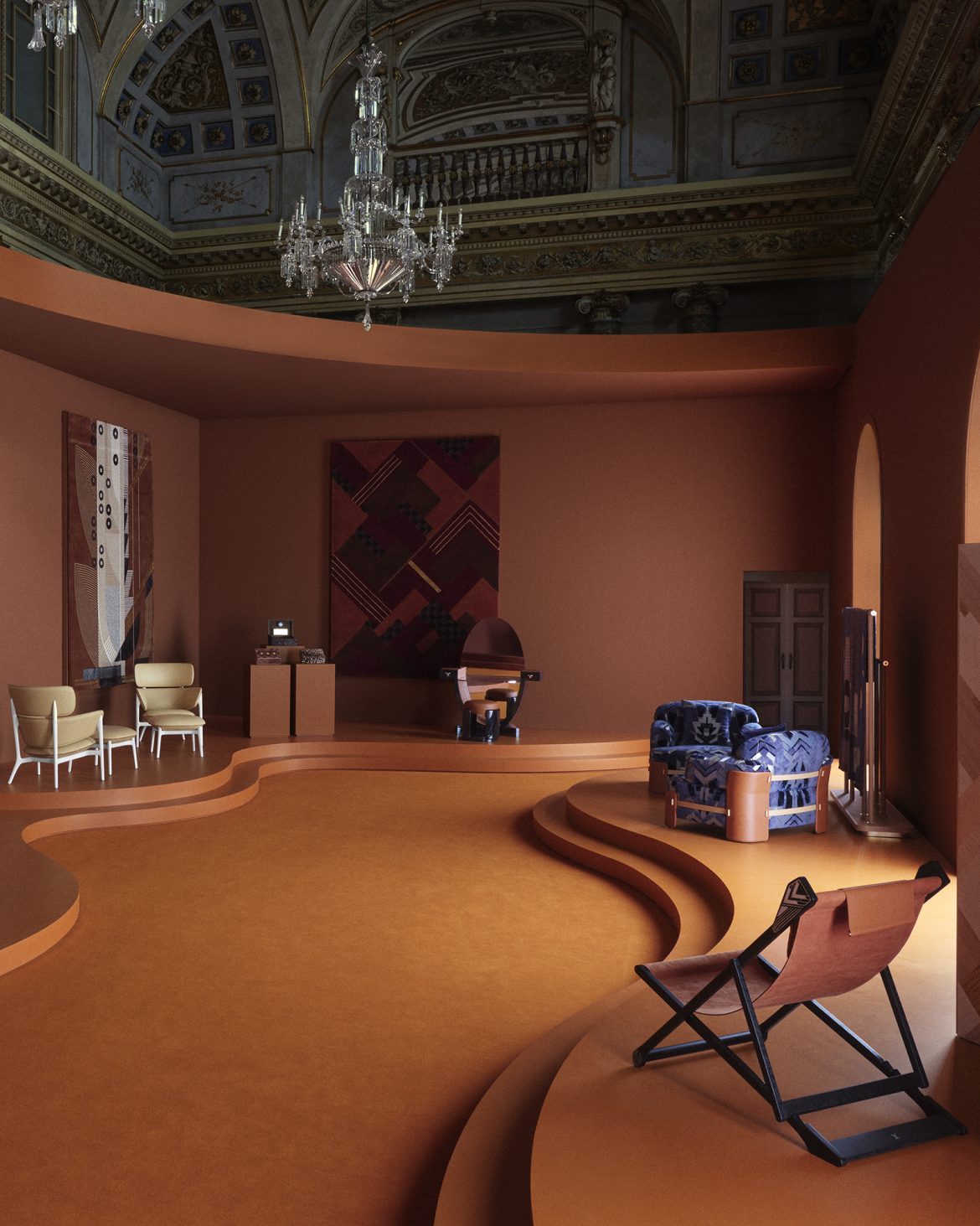
At Milan Design Week 2026, Louis Vuitton’s Objets Nomades unfolds less like a product presentation and more like a conversation— one that moves between past and present, object by object. Set within the hushed grandeur of Palazzo Serbelloni, the 2026 collection quietly revisits the language of Art Deco, not as a fixed style, but as a sensibility: disciplined, geometric, yet deeply sensual in material.

This year, that dialogue is anchored in the work of Pierre Legrain, whose early collaborations with the House helped shape its first experiments in furniture. His presence is felt not as nostalgia, but as a kind of design memory—surfacing in lines, in surfaces, in the way materials meet and resolve.

Since 2012, Objets Nomades has been a space for such encounters. In 2026, it feels more immersive than ever—less about objects in isolation, and more about how they live, reflect light, and hold the hand.
The Pierre Legrain Hommage collection is where the story settles into focus. His work has always been about tension— between structure and ornament, geometry and touch—and here, that tension is carefully reinterpreted. A lacquered dressing table, f irst imagined in the 1920s, returns with a surface so deep it seems to absorb light, while its leather-wrapped elements soften the severity of its lines.

Riviera chair

Nearby, a Riviera chair reveals itself slowly: oak, leather, and mother-of-pearl inlay catching the light at different angles, never quite the same twice. Folding screens, patterned in marquetry, create shifting shadows as you move past them—less objects than quiet interventions in space.


What lingers is not just form, but surface. Legrain’s original fascination with bookbinding finds new expression in textiles— throws and upholstery that carry a tactile rhythm, where stitched lines and colour blocks echo the logic of his graphic compositions.

Cocoon hanging seat
Beyond the homage, the collection expands outward through contemporary voices. Estudio Campana returns with the Cocoon in a dichroic finish, its surface shifting between tones as though lit from within—at once soft and otherworldly.
Across these works, the emphasis is clear: design is not static. It is something you experience through movement, through touch, through the slow revelation of detail.

Raw Edges armchair
What distinguishes this year’s Objets Nomades is how insistently it draws you closer. These are not pieces that announce themselves from across the room—they ask to be approached, circled and considered from multiple angles.

Kaleidoscope cabinet
Take the Kaleidoscope cabinet by Estudio Campana. At a distance, it reads as a dense, faceted volume. Up close, it becomes something else entirely: hundreds of small leather fragments, each cut and set at slightly different angles, catching and scattering light like scales. The surface feels alive—irregular, almost restless—transforming a familiar material into something unexpectedly luminous.
Then there is the football table, reimagined with a kind of quiet exuberance. Hand-painted mermaids drift across its surface, while nacre inlay shimmers beneath, turning a playful object into something intricately layered. It is this balance—between whimsy and rigour—that gives the collection its particular energy.

Damier box

Flower Crown plate

Fragments tray
The smaller pieces carry this same sensibility. In the Flower Crown tableware, raised monogram petals trace the edge of each plate, their gilded surfaces catching light with a soft, irregular glow. The Twist glassware, blown in Murano, feels almost fluid even when still—its spiralled form guiding the hand as much as the eye. Nearby, the Diamond collection offers a quieter counterpoint: sharply cut crystal, precise and restrained, where clarity becomes its own form of ornament.

Collar armchair
Furniture, too, leans into this interplay of structure and softness. The Collar lounge chair curves inward, its leather upholstery wrapping the body in a continuous line, while the Aqua table by Franck Gensler introduces a different kind of tactility—cool marble above, leather-wrapped joinery below, a meeting of surfaces that feels both deliberate and intuitive.

Aqua coffee table
What emerges, piece by piece, is a collection that resists a single narrative. Instead, it builds an atmosphere—one defined by contrast: hard and soft, matte and reflective, precise and organic.
In that sense, Objets Nomades in 2026 feels less like a showcase and more like a landscape. One that invites you to slow down, to notice how light moves across a surface, how a material responds to touch, how form shapes experience. And in doing so, it returns design to something essential—not just how it looks, but how it feels to live with.
