
Story | Connie Li Photography | Rolex, Tom Lovelock, Ashley Neuhof
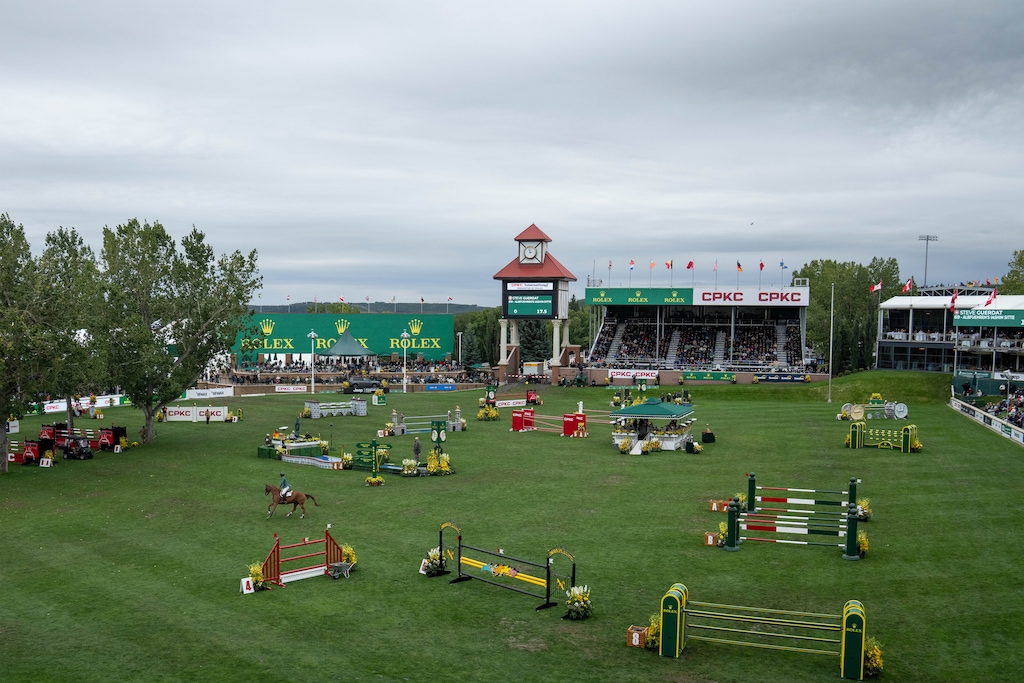
Spruce Meadows, the sprawling equestrian, sport and entertainment venue in Calgary covering roughly 500 acres, is one of the world’s leading show jumping venues. One of the four Majors in the Rolex Grand Slam of Show Jumping, the Spruce Meadows ‘Masters’ Tournament took place here from September 9 to 13 this year, bringing together 40 of the world’s leading horse-and-rider combinations for five days of elite competition.

The 2026 Spruce Meadows ‘Masters’ Tournament took place from September 9 to 13.


The competition reached its climax on the afternoon of September 13. Germany’s Richard Vogel entered the CPKC ‘International’ Grand Prix, presented by Rolex, knowing that victory would complete the Rolex Grand Slam of Show Jumping. With a demanding course and fences reaching 1.65 metres, anticipation filled the International Ring. Vogel’s historic bid ultimately ended in a six-way jump-off. Britain’s Ben Maher and Enjeu de Grisien prevailed, producing a clear round in 41.40 seconds to claim their first Rolex Major victory.


Ben Maher wins the CPKC ‘International’ Grand Prix, presented by Rolex at the 2026 CSIO Spruce Meadows ‘Masters’ Tournament.
A Partnership with Rolex
Rolex’s partnership with the Spruce Meadows ‘Masters’ dates back to 1989. In 2013, with the creation of the Rolex Grand Slam of Show Jumping, the CPKC ‘International’ Grand Prix was elevated to Major status; in 2014, Rolex became presenting partner of the event’s pinnacle class. This year’s field included several Rolex Testimonees from Great Britain, Germany, France and Switzerland, among them Germany’s Richard Vogel, the current World No. 1 in show jumping, and British star Scott Brash, winner of the 2025 edition.

Rolex Testimonee and World No. 1 Richard Vogel represents Germany aboard Cloudio in the 2026 BMO Nations’ Cup.
Anyone familiar with equestrian sport will have heard of the Rolex Grand Slam of Show Jumping. Established in 2013 and regarded as the “holy grail” of show jumping, it occupies a place in the sport comparable to the Grand Slams of tennis and golf.
The Rolex Grand Slam brings together four of the world’s most prestigious and historic equestrian Majors, including the Spruce Meadows ‘Masters’. Its challenge is formidable: a rider must win three consecutive Majors to complete the Grand Slam. To date, only one rider has achieved this extraordinary feat—Scott Brash, who made history with Hello Sanctos in 2015.

Scott Brash and Hello Jefferson win the CPKC ‘International’ Grand Prix in 2025.

Scott Brash Interview
Currently ranked World No. 3, Scott Brash is one of the most celebrated riders in modern show jumping. His achievements include team gold medals for Great Britain at the 2012 and 2024 Olympic Games, as well as five Rolex Grand Slam Major victories.
A Rolex Testimonee since 2015, Brash joined a virtual round table ahead of this year’s Spruce Meadows ‘Masters’, where eliteGen had the privilege of participating as the only Canadian media outlet. The conversation covered his extraordinary achievements and his understanding of equestrian sport, but also ventured well beyond competition, offering a more personal look at the rider behind the accolades.
Ten Years On, Learning to Be Patient
More than a decade after completing the Grand Slam, Brash remains at the very top of the sport. What allows a rider to sustain that level of performance for so long?
eliteGen asked Brash what had changed most over the past decade—his training, his mindset, or the way he chooses and develops his horses.
“Experience has taught me a lot,” he replied. “For example, knowing which horse is suited to which venue.”
Rather than placing the burden of major competitions on a single horse, Brash now focuses on developing a strong group of horses and choosing the right partner for each venue.
“Hello Chadora Lady might enjoy one arena more than Hello Jefferson, so we are always trying to manage that,” he explained. A top team—horses, staff and owners—is equally important in making those decisions and allowing each horse to compete where it is best suited.
There is another quality that experience has taught him: patience.
“When I was younger, I was so hungry to win every time I went to a competition,” Brash said. “Now, I plan more constructively for the top competitions. Experience helps with that.”
For a rider who has won so many of the sport’s biggest prizes, experience has not necessarily intensified the desire to win every time. Instead, it has taught him when to push for victory — and when to wait for the right moment.
No Two Horses Are the Same
Throughout the conversation, Brash kept returning to one subject: the horses. “Knowing” and “understanding” each horse is central to the way he approaches the sport.
Hello Sanctos, with whom he made Grand Slam history, was calm and self-assured. Hello Jefferson, who carried him to victory at Spruce Meadows last year, could hardly be more different.
“Hello Jefferson is probably one of the trickiest horses I have had, and I have spent more hours of my life working with him and building that connection because he is a strong character,” Brash said.
He offered a vivid example: “If you say black, he will say white. Even simple things like turning left—sometimes, when you turn left, he takes a step right first and then turns left.”
Hello Folie is almost the opposite. “The minute I even think about turning left, she turns left, and sometimes too quickly.”
“We have to adapt our riding to each horse,” he explained. “These are the sorts of things we work on every day.”
Those differences in temperament have been particularly apparent at Spruce Meadows. Brash recalled arriving in Calgary with Hello Jefferson several years ago believing the horse was in excellent shape, only for the pipe band at the opening ceremony to disrupt his concentration.
“I had Hello Jefferson down in the collecting ring and he saw and heard them. That was enough to ruin his relaxation and a lot of the hard work that had gone into getting him in the best shape for that show. It ruined our chances that year.”
Last year, the team learned from the experience. “We kept him away from the pipe band and from those things that we know can unsettle him. He was very relaxed and in top shape, and I think that is why he won.”
For Brash, getting a sensitive horse to relax is one of the hardest things to achieve. That is why, despite all he accomplished with Hello Sanctos, he considers winning at Spruce Meadows with Hello Jefferson “probably the more challenging of the two.”
“The Horses Must Come First”
Technology and data are playing an increasingly important role at the highest levels of equestrian sport. Fitness, weight, blood levels and other indicators can now provide teams with information that previous generations of riders never had.
Brash welcomes these developments. “We have to embrace the new innovations in the best interests of the horse, while not forgetting our roots and what we know.”
But data has its limits.
“Even today, there is no better feeling than my own connection with a horse to know whether they are in good shape or not, aside from what the data may say.”
That belief is closely connected to the “horse first” philosophy Brash has followed throughout his career.
Two weeks before his historic Grand Slam victory in Calgary in 2015, the European Championships were taking place in Aachen, where Great Britain was still seeking Olympic team qualification. Brash chose not to compete with Hello Sanctos.
“That came with some criticism at the time, but those are the decisions you have to make,” he recalled. “In the interest of the horse, I will always put them first.”
For Brash, asking Hello Sanctos to compete in a European Championship only two weeks before attempting something no rider had ever achieved in Calgary was simply not in the horse’s best interest.
He later made a similarly difficult decision ahead of the Rio Olympic Games. “I would have loved to have been there, but I did not feel I had a horse capable of going there at the time, so I took myself out of selection.”
“I will always put the horse first, whatever that means for everyone else,” he said. “It is how I am and how I have always been. The horses must come first in what we do.”
It also explains why, when asked what stands out most when he looks back on Olympic gold, the Rolex Grand Slam, his MBE and his many other achievements, Brash did not choose a trophy or title.
“The partnership with my horses is what stands out most,” he said. “Whether you are going for an Olympic gold medal or trying to win another Rolex Major, I would like to think it is our partnership and the work we have achieved together—whatever the goal might be—that shines through the most.”
“80 or 90 Percent of the Time We Are Not Winning”
With a résumé like Brash’s, it would be easy to imagine that winning has become almost routine. His own description of life at the top of the sport tells a very different story.
“Our sport is unique because 80 or 90 percent of the time we are not winning.”
A rider can be in peak condition, but if the horse is not, victory is impossible. Even when both are in prime condition, Brash points out, “you can go through a run of having four faults, or injuries, or whatever it may be.”
“There are many highs and lows, so you must try to stay as level as possible,” he said. “Enjoy the good moments, without getting too far ahead of yourself, because horses can bring you right back down to earth the next day.”
What keeps him coming back is, once again, the horses.
“Even today, I am striving to produce the next top horse,” Brash said. “I love working with horses and trying to bring out the individual attributes they have.”
“A horse is born with attributes, but they are not born a superstar. You have to work with them every day to bring out those qualities and show the world how good that horse is.”
Even after a career that has already earned him a unique place in show jumping history, the search continues.
“I am always trying to find the next 5* Grand Prix winner,” he said. “I still have that hunger.”
“That Extra One Percent”
When you are already the only rider in history to have completed the Rolex Grand Slam of Show Jumping, what does it mean to become better?
eliteGen asked Brash about Rolex’s “perpetual pursuit of excellence.” Having experienced both historic victories and the pressure of remaining at the top, what does excellence mean to him today compared with earlier in his career?
Brash did not define it in terms of trophies or rankings.
“Excellence has always meant a lot to me, and we are always searching for it,” he said. “I do not know if the perfect round has ever been ridden, or if the most perfect, precise combination [of fences] has ever been completed.”
“This is what we all search for—that extra one percent to be better, more dedicated, more committed and successful in our sport.”
Brash also spoke of fellow Rolex Testimonees, particularly Roger Federer, who remains a role model.
“When you look at the Rolex Testimonees, the likes of [Roger] Federer and athletes of that level, they are still my role models today. I look up to them and aspire to be like them. I will try to leave a legacy in the sport I love.”
For a rider who has already accumulated more than enough victories to define a career, perhaps this is what the next stage of excellence is about: continuing to win matters, but so does what you ultimately leave behind.
If There Were a Scott Brash Rolex…
During the conversation, eliteGen also posed a more playful question. Rolex watches often become deeply personal objects over time. If there were one day a Scott Brash edition, what details would he want it to include to tell his story?
“It is hard to top the watches Rolex has already made, because I have fallen in love with quite a few,” Brash said. “To reflect my personality, I would like to think the hard work, commitment and dedication that goes into making a watch also shares the values I believe I have.”
As for the design, he had two distinctly personal ideas.
“It would be nice to have something related to horses, and perhaps a touch of Scotland, where I came from.”
Horses and Scotland: it would be difficult to find two symbols that tell the Scott Brash story better. He began riding in the Scottish Borders, and his young horses are still bred and born there today. When preparing horses for a major competition such as Spruce Meadows, he believes there is nowhere better than the Scottish hills where it all began.
“I still recognize where I have come from,” he said. “I always love going home to the Scottish Borders and seeing my horses growing up there. That grounding keeps me committed to the daily work and to always trying to improve.”
So what might a Scott Brash Rolex actually look like?
This time, Brash was happy to leave the answer to Rolex.
“I do not know exactly how it would look, but Rolex would be the best to design something like that if it were ever to happen.”
