
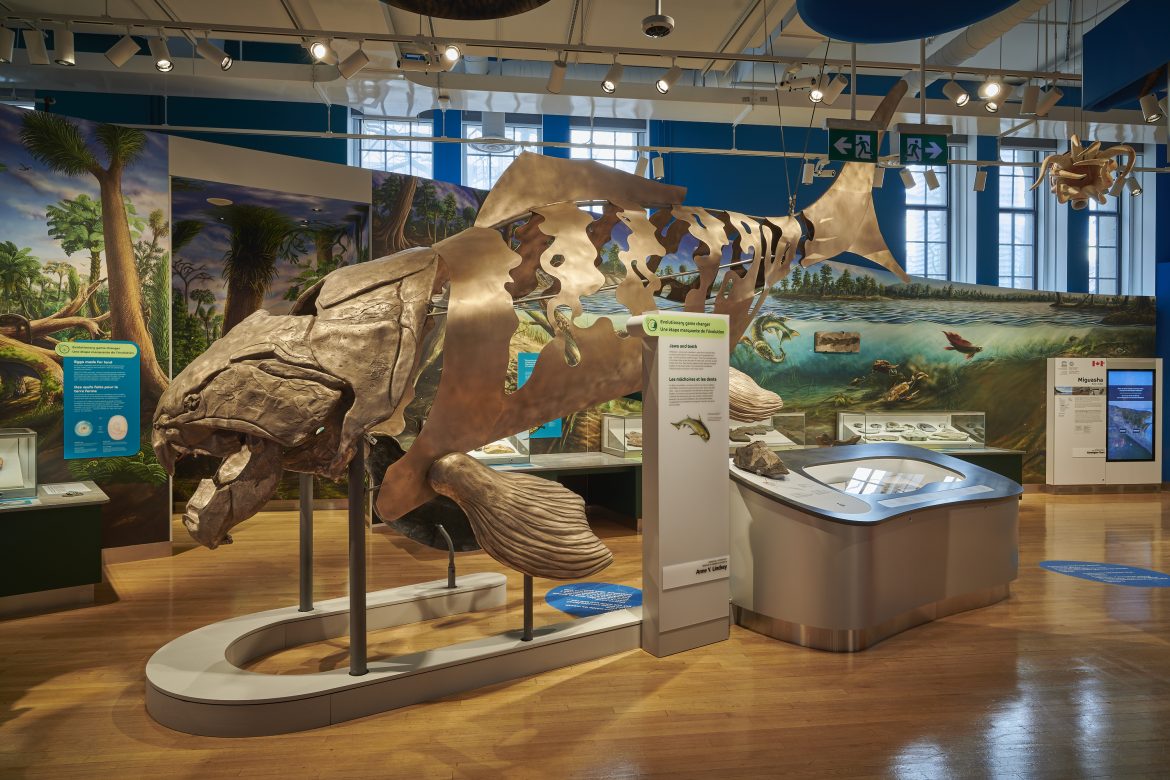
The first and only one of its kind in North America, Royal Ontario Museum (ROM) unveils the Willner Madge Gallery, Dawn of Life, the Museum’s highly anticipated new gallery that explores early life on Earth and 4 billion years of evolution—life before the rise of dinosaurs.

With 10,000 square feet of custom-designed gallery space, Dawn of Life, located in the Peter F. Bronfman Hall, will feature almost 1,000 fossil specimens from 4 billion to 200 million years ago, drawn extensively from ROM’s world-class palaeontology collections – including specimens discovered by ROM that have fundamentally altered our scientific understanding of life during the Cambrian Explosion. This galley is designed to engage visitors of all ages through leading-edge presentation techniques and technology. Many of the fossils are brought “to life” through original ROM scientific artwork and animation, transforming ancient rock into brilliant living history for families and kids to experience and learn with one another.

The gallery is divided into several thematic areas: A Very Long Beginning (Precambrian), The Origin of Animals (Cambrian Explosion), The Bustling Seas (Ordovician/Silurian/Devonian), The Green Earth (Devonian/Carboniferous), Before the Great Dying (Permian) and Dawn of a New Era (Triassic). The exceptional quality of this gallery is only possible because of the fossils of great scientific value found within Canada, so much so that four locations are recognized as UNESCO World Heritage Sites. Each of these fossil sites provides astonishing evidence of major intervals in life history, from oldest to youngest, they are: Mistaken Point (Newfoundland and Labrador), the Burgess Shale from Yoho and Kootenay National Parks (British Columbia), Miguasha National Park (Québec) and Joggins Fossil Cliffs (Nova Scotia).
An especially noteworthy section is the Burgess Shale display, which features nearly 200 fossil specimens, world-renowned for their exceptional preservation of soft-bodied animals from the 506-million-year-old marine Cambrian ecosystem. Through an ongoing ROM research program, the Museum holds the world’s largest and best collection of Burgess Shale fossils in trust for Parks Canada. With the opening of Dawn of Life, these scientifically important fossils will now have a prominent and lasting museum display. An additional section will present the latest in ongoing Burgess Shale research and feature newly discovered creatures. And to bring this dramatic ancient world to life, a 48-foot-wide wide curved video wall will display a spectacular animation of the Burgess Shale ecosystem.
Dawn of Life also highlights climatic and tectonic changes that altered the course of life. Within the gallery’s timeframe, four of the five largest mass extinctions occurred, including the largest extinction 252 million years ago at the end of the Permian Period, which destroyed 90% of life in the oceans.


