
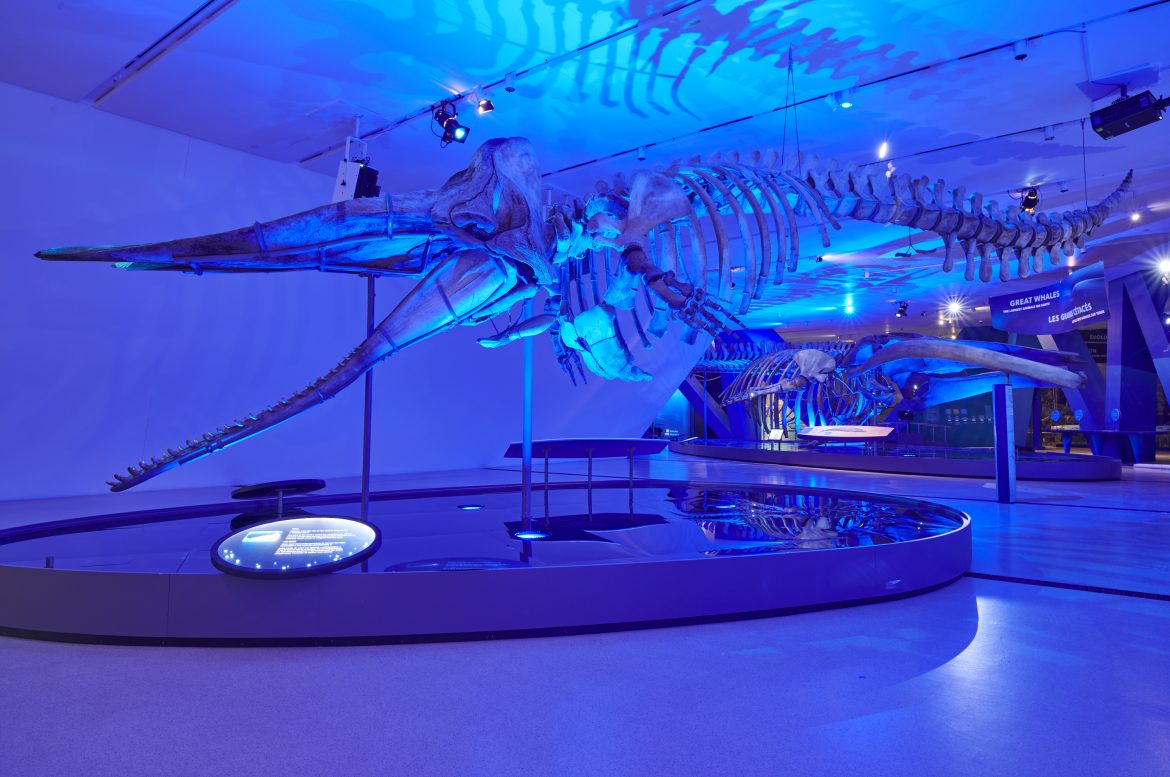
This summer, ROM Exhibition explores the extraordinary stories of great whales and invites visitors to venture beneath the surface and discover the fascinating and enigmatic world of Earth’s largest animals. Great Whales opens to the public Saturday, July 17, 2021.

Featuring three real whale skeletons, fascinating science and large-scale audio and video experiences, this major new ROM exhibition immerses audiences in the unique world of the majestic giants that swim off the east coast of the lands now known as Canada.
Great Whales brings visitors intimately into the lives of these massive and enigmatic creatures, exploring their evolution, behaviour, ecological roles, threats, and their complex relationship with humans. Visitors will connect with the extraordinary stories behind the lives of these species through large-scale immersive video projections, a rumbling sound chamber, and a gigantic life-size walk-through whale jaw. The exhibition is shaped by, and incorporates, the deeply personal Indigenous connections with the lives of whales.
In Great Whales, visitors encounter a sperm whale, who died after beaching himself on a sandbar near Kildare Capes in western Prince Edward Island on the night of Tuesday, December 12, in 2001. Also featured in the exhibition is the return of ROM’s blue whale; she was one of nine that were trapped by ice and perished in the Gulf of St. Lawrence in 2014 after coming to the area to feed. The third of the great whales is a North Atlantic right whale, which had survived at least three entanglements with fishing gear during his life before a ship strike in the Gulf of St. Lawrence killed him in 2017. Right whales were once common in the Bay of Fundy from spring to fall, where they came to feed on an abundance of copepods, but climate change has forced their food source, and thus the whales, to move into the waters of the Gulf of St. Lawrence, where tragically 11 others also perished that same year.

North Atlantic right whale near Norway Beach, Prince Edward Island, 2017

Sperm whale showing spine and ribs near Kildare Capes in western Prince Edward Island, 2001.

The blue whale which washed up at Trout River, Newfoundland in 2014
The opportunity to see the three whale species up close—especially for visitors who live far from the oceans—is a critical step in their conservation, explains Dr. Mark Engstrom, Curator Emeritus of Mammals and lead curator of Great Whales.
“It is poignant, that what brought these three whales together at the ROM is their individual tragic deaths. It is through getting to understand these whales better that we can start to learn how to save them,” says Dr. Engstrom. “To see whales swimming freely is a profound experience, matched only by the heartbreaking task of working on their remains,” he says. “Our contribution at the ROM is to learn as much as we can, study their anatomy and DNA, what it says about their populations, and share with the public why it’s critical to preserve and protect them and their ocean environments.”
