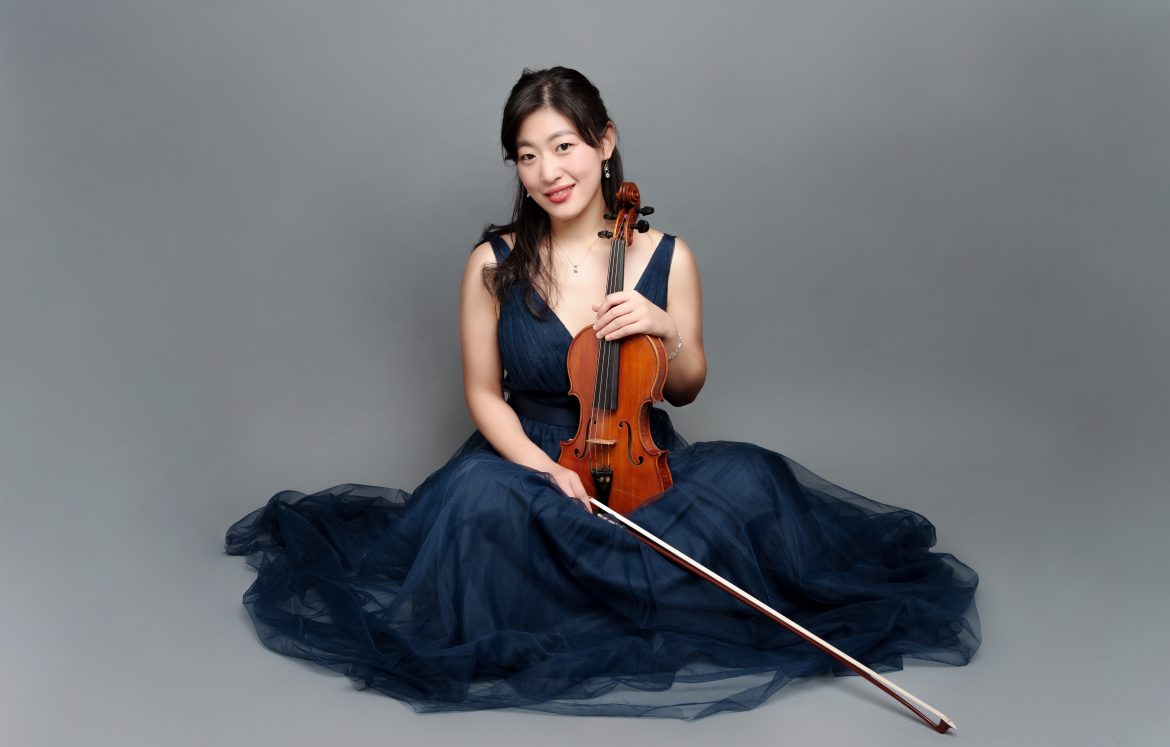
Story | Connie Li Photography | Courtesy of Sheng-Ching Hsu, Misaki Saito with 2/34 LAB
Music produces a kind of pleasure which human nature cannot do without—Confucius
Acclaimed violinist Sheng-Ching Hsu doesn’t believe she was born to become a musician. Rather, “It’s more like the art found me and I couldn’t live without it.”

Hsu was born and grew up in Tainan, Taiwan’s oldest city and its first capital. For music advancement, she moved to New York at the age of 17, staying for more than a decade and completing her degree there.

Since then, she has travelled around the world as a freelance musician, including a few years performing on the Lincoln Center Stage aboard a Holland America Line cruise ship. When Covid-19 hit, she moved to Los Angeles.

This nomadic existence has convinced her that there are many ways to live life, with endless possibilities to reap the rewards, as long as one makes the effort. Along the way, she is perfecting
her art through relentless work.

Her parents are both music lovers—her father used to set biblical passages to music—and they
encouraged their children to learn music.
While Hsu was still a toddler, she asked to have “my own music lessons” rather than sitting at the back of the room during her older sister’s lessons. Not long after, she began to play the piano and
then took up the violin about a year later.
She preferred the piano at first, because she could play sitting down and her fingers wouldn’t blister. Slowly though, she felt a stronger connection with the violin, as it is played much closer to her ears, brain and heart.
However, there were times when Hsu found practising the violin too hard and set it aside. After a while, she would miss it and then pick it up again. Soon she found that the more she played, the more she enjoyed it.

The girl from Taiwan named her instrument “Sheng-Chin,” to rhyme with “violin.” It’s her closest companion, with whom she performs worldwide—together as one. Every time before she plays, she will scrub her hands clean as a sign of respect to Sheng-Chin .
“I talk to her all the time, asking how she is, saying ‘good job’ after a performance,” Hsu says. “I have my 15-minute warm-up routine that I do when there is limited time to practise. It keeps me feeling close with the instrument. I complain to her as well, of course. We don’t always get along.”

She had her fair share of tough challenges playing violin. At one point, she damaged the nerves of four fingertips, forcing her to stop playing. She started to question whether it might be time to quit.
“If there was one point at which I considered giving up playing music, it was when I realized that my fingers were still affected, even years after the damage happened,” she says. “It’s really hard and painful not being able to fully control my fingers, but it would be harder if I lived without playing music anymore. So why not go for the less hard option, try the best I can and see where it takes me?”
So Hsu began gruelling rehabilitation and worked on the basics. She has continued to experience pain over the past few years, but she has soldiered on with this mantra: “Try my best and see where
the hard work takes me.”

The challenges didn’t stop there with the pandemic robbing her of all work opportunities. With no stage on which to communicate with the world through music, she felt stifled, but still found comfort in music.
During the pandemic, she knew that she wasn’t alone in needing comfort and encouragement, so she set up S-C Sidewalk Performances to play violin at different street corners in Los Angeles every week. Her music brought thank-you notes from healthcare workers, tears from big guys and warm embraces between couples. Sometimes kids would dance to her music.
There were times when she was alone on her corner, seemingly having only plants and traffic lights for an audience. But then applause would erupt from neighbourhood balconies and she realized there were admirers around her after all.

“I realized that it brought myself, and perhaps other people, out of the isolation and the depression from the pandemic—even just for a short moment,” she says. “To experience the power of music in such an unexpected way was beautiful. That makes me feel alive and reminds me of what I can do to help.”
Hsu grew up as an introvert, but the violin became her way of communicating with others. She hankers for the pre-pandemic chamber music cruise ship performances, where she entertained travellers in different ways every day. She also misses the “electrifying” chemistry playing with the passionate musicians of Delirium Musicum.
“How others receive music is different, depending on the individual. If I give someone joy by entertaining them, that’s awesome.”
“Personally I like J. S. Bach and S. Prokofiev. Bach’s music is so pure and yet complex. It is something one plays through their entire life. As for Prokofiev, his music can be elegant, dark, humorous and innocent yet full of variety, but meanwhile so unique that you recognize it is him right away.”
Hsu says she listens or plays Bach in the dark to release emotions. “I try to make the room as dark and quiet as possible, so I can really focus on other senses at the moment.”

The interaction with the public makes Hsu more inclined these days to play works by living composers, especially by friends and colleagues. This gives her a satisfying sense of contributing to the birth of a piece.
This February, she took part in the Treelogy project in collaboration with Delirium Musicum, a chamber ensemble performing in California. As a freelance professional violinist, she often has novel artistic experiences come her way because of the unpredictability of being a “violinist for hire,” so to speak.
Her plans are to play with the Delirium Musicum and California Symphony throughout the first part of the year, whilst also preparing for performances and an album release in May. Her duties providing violin lessons as an adjunct professor in Bob Cole Conservatory of Music at Cal State Long Beach also keep her busy. In the face of a hectic schedule, she finds it helps to maintain a routine.

“If I can, I make my coffee in the morning and have some quiet moments with my cat Tigger before starting the day. I’ve found that if you focus on what you are presenting, at one point anxiety turns into excitement.”
Over the years, Hsu has visited many places and met many people worldwide, thanks to Sheng-Chin, the violin. “I am not sure if it is being Taiwanese or Asian necessarily, but I do think that experiencing and seeing more cultures enriches our lives, which adds so much nuance to the works we create,” she says.
Hsu is truly centred in her head and in her heart. What’s left to do is to enjoy and share her music.
“Since you can never fully predict what will happen, there is only one thing you can do and that is to enjoy it. If accidents happen, it’s okay. It is all part of experiencing the moment.”