
Story & Photography | Renée S. Suen
Food and wine connoisseurs have long sung the merits of Spanish wines, but surprisingly the spotlight hasn’t included the country’s white varietals. Located in Castile-León region, Rueda, aka Spain’s most important white wine region, is known as a Spanish Denominacion de Origen Protegida (DO), for wines and encompasses 74 municipalities in northwest Spain.

The beautiful and modern estate, plus views from Finca Montepedroso, are highlights of this winery, located on 25 hectares of vineyards.
Nearly 95 per cent of all wines in DO Rueda are whites, made mostly with the Verdejo grape, indigenous to the flat high plains south of Valladolid. The region also produces quality produce, like pine nuts and raw sheep’s milk cheeses.
Prized for its aroma and flavour, Verdejo is characterized by its fresh fruit flavours, refreshing acidity and herbaceous notes. It was in the 1970s that Rioja producer Marques de Riscal identified the potential for Verdejo to address the increased demands for refreshing white wines.
The region’s dry climate and well-drained sandy-clay soils, along with 100-year-old vines, result in depth that’s possible only from older vineyards. Paired with long cold winters and drastic temperature changes of hot dry summers with freezing cold nights, these mediumsized fruit end up having high sugar and acidity.
A unique characteristic in the production of Rueda wines is that it’s mechanically harvested at night. Void of sunlight and heat that would expedite oxidation, the grapes are brought into the wineries to ferment in temperature-controlled stainless-steel tanks at lower temperatures to ensure clean and pale juice.

For the full experience, catch the night harvest in Rueda every September, which is typically mechanical.

For the full experience, catch the night harvest in Rueda every September, which is typically mechanical.
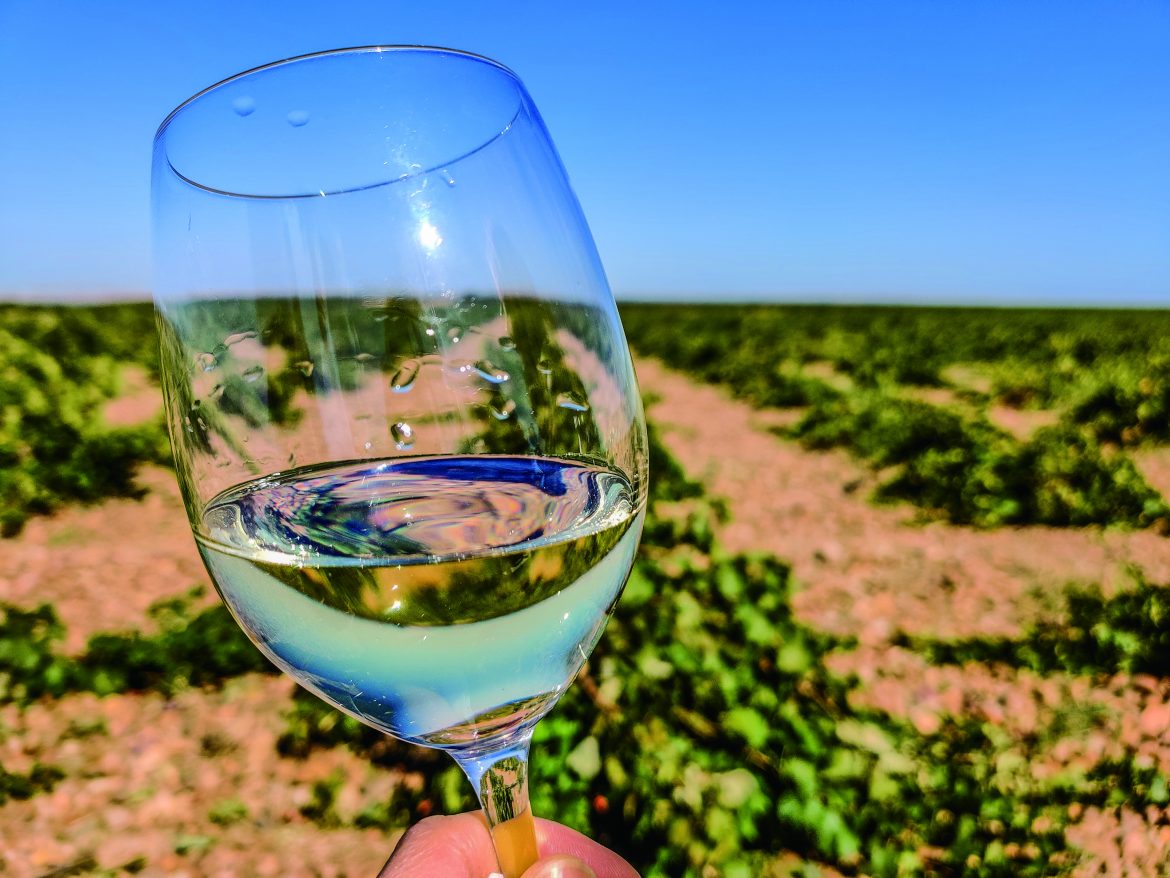
At bottling, the un-oaked, pale-yellow wine has a hint of green, full, fresh fruit flavour. Some wines are barrel fermented, which adds toasty oak and vanilla to the fruit-forward wine. Others are aged on lees, resulting in a rounder, more structured wine. More recently, some DO Rueda wineries have used concrete eggs to ferment the wines, which produces a more complex product.

Oro de Castilla (meaning “the Gold of Castile” shown here) is the flagship wine from Bodegas Hermanos De Villar and is considered by many as the reference point for Verdejo.
DO Rueda has created different colour-coded back labels to help identify its wines. Still wines with young, light and fresh profiles are green, fortified wines that have been oxidized in oak barrels at least two years are gold and sparkling wines are blue. The Gran Vino Rueda have black labels, meant to identify wines made from low-yield vineyards that are more than 30 years old.
The easiest way to navigate the region is to fly to Madrid and drive into the wine appellation via the A-6 motorway, or from other points in the country by train. Whichever option, it’s always wise to plan out the experience, reserving tasting rooms well in advance.

The 16th-century Valladolid Cathedral, located in the city centre, is admired for its Renaissance style.
Valladolid is an excellent home base from which to explore the 74 wineries in Rueda via the CL-610 and the N-601. If you stay in the city, stop by Los Zagales for an award-winning contemporary gastronomic tapas experience with whimsically plated dishes like breadbag, cigarshaped Puro de Sardina, uber-creamy croquetas spilling over with squid ink, octopus, or ham and chicken filling. Or, feast on shrimp simply cooked on the plancha at El Corcho. At Trigo Restaurante, a one-star Michelin establishment just steps away from the city’s early 16th-century, Renaissance-style cathedral, you can taste the exceptional wines that lean largely Iberian.

Valladolid’s award-winning tapas bar Los Zagales is known for its whimsical dishes, like these cigar-shaped Puro de Sardina.

Segovia’s Mesón de Cándido serves a suckling pig that is ceremoniously cut before service.
Near Valladolid, there’s Bodegas Pandora. Here, winemaker Rosa Zarza Gil released the first vintage only in 2020. Aged six months on lees, the wines are made from a blend of fruit from different parcels. The result is balanced with concentrated flavours, structure, textural and aromatic complexity in both their value-driven entry Ariabal and flagship Pandra.

The winery views from Bodegas Pandora.
In La Seca, Bodegas José Pariente celebrates the legacy of owner and winemaker Victoria’s late father. Experience the winery first with a tour of the vineyard’s monovarietal plots and cellar, before a guided tasting of wines, including fresh and elegant entry-level Verdejo to the complex and classic herbaceous Cuvée Especial that uses Verdejo grapes from old vines that have been aged for 11 months on its own lees in oval concrete vats.

In the cellars of family winery Solar De Muñosancho in La Seca, award-winning wines, including Prius, are produced.
There’s also Martinsancho, a small winery with a family history in winemaking dating back to the 17th century. The manually harvested fruit from this traditional, pre-phylloxera bush vineyard produces only one wine, Martinsancho Verdejo.

Visiting Castelo de Medina’s fermentation room just after harvest provides a glimpse into the production of these longer and lower temperature fermented wines.
At family-run Garciarevalo vineyards in Matapozuelos, oenologist Reyes Martinez-Sagarra makes vibrant wines from organic old-vine verdejo grown in sandy soils. There is the completely organic and easy to drink Tresolmos Verdejo Classic and the stunning, full-bodied Harenna that’s made using fruit from 150-year-old vines and aged six months on lees in clay amphora.
Bodegas Protos winery’s Verdejo was accorded the “best young wine in Spain” award by Guía Vinos Gourmets 2019. It has medium intensity of pineapple and apple, but a good balance of freshness and acidity, plus body as a result of being aged on fine lees for three months. Also available are the Organic and the Reserve that’s been fermented for seven months, resulting in wine with longer and more expressive characteristics.

Bodegas José Pariente oenologist Martina Pariente makes vibrant wines from organic old-vine Verdejo grapes grown in sandy soils.
But don’t miss stopping by Bodegas Castelo de Medina in Villaverde de Medina that’s been producing high-quality white, rosé and red wines since 1996. The World Association of Wine Writers and Journalists awarded it the Best Verdejo of the World in 2014 and 2016, Best Sauvignon of the World in 2016 and Best Rosé from Spain in 2016. Aged in barrels and concrete eggs in the winery’s underground barrel room that’s dug into the hill, the prized wines are bottled on the estate.
Of the winery’s crowd-pleasing lineup, that includes the Verdejo and Sauvignon Blanc, it’s the Verdejo Prefiloxérico that comes from centenary vines that is the standout. Limited in availability, and packaged in its own box, the elixir is smooth and silky with complex aromas, minerals and a touch of spice.
