
Story | Leslie Yip Photography | Louis Vuitton
Some luxury handbags mark a celebration. A birthday. An anniversary. A first paycheque. A long-awaited bonus. A promotion that quietly says, “I have arrived.”
Some are declarations. A sign that one has stepped into a certain world, earned a place or reached a milestone once imagined from afar.
Some are investments, admired for their craftsmanship, scarcity and enduring value.
But for many people, a handbag becomes something more personal: a promise.
A promise of love, when it arrives as a gift from someone who knows what it means. A promise of success, when it is bought to honour a career beginning or a goal achieved. A promise of continuity, when it is chosen not only to be worn, but to be kept, to accompany and, perhaps one day, to be passed on.

Few Maisons understand this better than Louis Vuitton. Since 1854, the House has built its identity around the Art of Travel, creating trunks and bags designed to move through the world with elegance and resilience. One of the most enduring pieces of House lore tells of a Louis Vuitton trunk surviving the sinking of the Titanic, its contents protected by the strength of its construction. Whether understood as legend, history or metaphor, the story captures something essential about Louis Vuitton: the belief that a travel companion should withstand not only distance, but time.
Of course, we all hope never to encounter icebergs, literal or otherwise. Still, life leaves its own marks. A spilled drink. A sudden rainstorm. A teething baby. A curious puppy. The friction of travel. The pressure of daily use. Or simply the quiet passage of years, written slowly into leather, canvas, corners and handles.


When an object has carried so much of a life, replacing it can feel impossible. This is where Louis Vuitton’s Care & Repair service becomes more than a practical offering. It becomes a continuation of the House’s original promise: that a piece created with care deserves to be cared for in return.
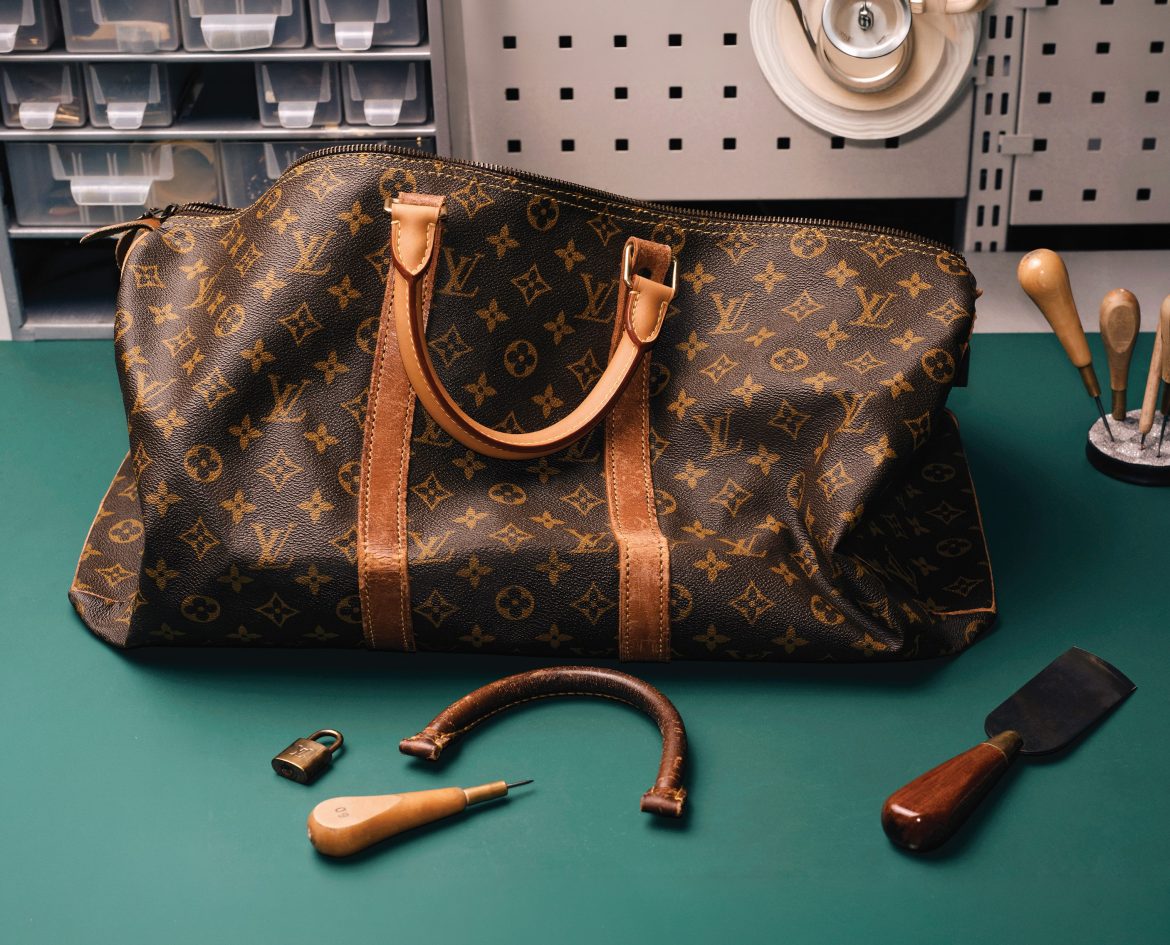
Repair has been part of Louis Vuitton’s history since the beginning. Its trunks and bags were designed to travel through space and through time, with longevity embedded in their construction. Today, that philosophy continues through a global network of 11 repair workshops, where skilled artisans restore hundreds of thousands of pieces each year. Leather goods and shoes can already be repaired, with services set to expand across all product categories by 2030.
Yet the most meaningful repairs rarely begin with the object alone. They begin with listening.

At Louis Vuitton, each Care & Repair request starts with a conversation. Client advisors seek to understand not only what has happened to a piece, but what it represents. Is it a family heirloom? A memory of travel? A gift from someone beloved? A first luxury purchase? For vintage trunks and exceptional pieces, the process may even involve research with the House’s Heritage Department, tracing origins, structure and historical details before a single intervention begins.
This attention matters because every piece arrives with a different kind of emotion.
In Paris, a woman nearing 90 brings in a Boston Sport bag from the 1970s or ’80s, accompanied by her granddaughter. Purchased decades earlier at Louis Vuitton’s former Avenue Marceau store, the bag has crossed continents and returned home with her through a lifetime of journeys. Restored with respect rather than made new, it is prepared for its next chapter, passing from grandmother to granddaughter.
In Singapore, a loyal client quietly arranges the restoration of his wife’s first-generation Neverfull from 2007, one of her earliest Louis Vuitton bags. The leather elements are replaced, but the soul of the piece remains intact. What returns is not a new bag, but a renewed memory of a beginning.


A young mother brings in her mini Speedy after her baby leaves tiny teeth marks on the handles. Technically, they are damage. Emotionally, they are traces of a fleeting season, when everything precious must survive a little chaos. The handles are replaced so the bag can continue its daily life, while the memory remains.
In Osaka, a woman arrives with a Noé she bought 25 years earlier with her first bonus. Worn from years of work, travel and motherhood, it is too meaningful to replace. Restored with care, the Noé becomes not simply a repaired bag, but a mirror of time traversed.
These stories are not exceptional because accidents happened. They are exceptional because the objects mattered enough to be saved.


That distinction shapes the work of Louis Vuitton’s artisans. It takes several years of training to become a Care & Repair artisan, and the discipline is grounded in both traditional techniques and continual refinement. At the House’s dedicated repair atelier near Paris, coated canvas is meticulously cleaned, leather is polished or recoloured with resin creams enriched with nourishing ingredients, and exotic skins receive specialized care. On a crocodile bag, each scale may be cleaned individually, polished and conditioned.
Elsewhere in the atelier, artisans repair leather goods with the understanding that a bag may carry a meaning far greater than its form. Another area is devoted to trunks and cases, where cleaning, structural repairs and brass polishing are performed with the goal of restoring functionality and lustre while preserving history.
That last phrase is essential: preserving history.
In the luxury world, restoration is sometimes misunderstood as a pursuit of newness. But true savoir-faire often lies in knowing when not to intervene too much. One of the most revealing Care & Repair stories involves a vintage flap cartridge bag, aged and emotionally charged. Too radical an intervention could correct the material while disturbing the memory. In the end, the artisan chooses restraint: nourishing the leather, supporting the structure with satin cushions and leaving the character intact. The bag departs not transformed, but understood.


This may be the most refined form of craftsmanship: not the dramatic before-and-after image, but the quiet judgement that asks what should be restored, what should remain, and which marks belong not to damage, but to life.
For clients, access to Care & Repair is intentionally straightforward. The service is available through Louis Vuitton stores, where advisors guide clients through assessment and options. In selected countries, it is also available through the Louis Vuitton app. Behind that ease, however, is a vast network of expertise: 11 workshops around the world, nearly 600,000 items handled each year, and artisans trained to treat each piece not as a product returning to service, but as an object returning to someone’s life.
That human dimension is what makes Care & Repair feel so relevant now. At a time when sustainability is often discussed in abstract terms, repairing a cherished object is both practical and emotional. It extends a product’s lifespan, but it also challenges the impulse to replace. It acknowledges that value is not only found in pristine condition, but in continuity. A piece can be worn, marked, restored and loved again. It can carry evidence of the past while being prepared for the future.
In one story, a mother restores a first-generation Speedy so it may be passed to her daughter on the occasion of her wedding. The leather is renewed with a subtle patina, chosen to respect the age of the piece rather than make it look abruptly new. Its corners are strengthened, its structure rebalanced, its future restored. The bag now holds two narratives: the life already lived by one woman, and the life about to begin for another.


In Hong Kong, a woman entrusts Louis Vuitton with her very first piece from the House, a gift from her husband. A water leak has marked the leather, but the damage is not what defines the bag. What matters is the life it represents: the promise of a marriage, the tenderness of a first gift, the memories absorbed into an object kept with care. Through repair, the material is restored, but something else is also reaffirmed: the bond between object, owner and memory.
That is why a service like this resonates beyond fashion. A handbag may begin as an accessory, but over time it becomes an archive. It carries passports, receipts, lipstick, keys and sunglasses. Then, almost without our noticing, it begins carrying other things: a first job, a long trip, a marriage, a child, a parent, a version of ourselves we no longer are.
To repair such an object is not simply to fix leather or polish brass. It is to honour everything that has travelled with it.
Forever, in fashion, can sound like a fantasy. Trends change. Lives change. Even the most beautifully made objects show signs of use. But perhaps forever does not mean untouched. Perhaps it means worthy of care. Worthy of renewal. Worthy of being carried again.
At Louis Vuitton, Care & Repair gives that promise a form. It allows a bag, a trunk or a pair of shoes to continue its journey, not by denying time, but by respecting it.
Because the most meaningful luxury objects are not the ones that remain perfect.
They are the ones that stay.
