Every time I speak with family and friends in Hong Kong, they rarely say so outright, yet the thought inevitably arises: “Why not return to Hong Kong for Lunar New Year?” As the festive season approaches, homesickness grows especially strong. Indeed, beyond reuniting with loved ones and enjoying precious family time, Hong Kong’s unique celebrations and the citywide festive ambience are impossible to find elsewhere. This one-of-a-kind charm makes the idea of welcoming a blessed and prosperous new year in Hong Kong irresistibly appealing.

This year, the first day of Lunar New Year falls on February 17, and the ideal itinerary would begin around February 10. Although Canada hosts its own holiday fairs, none compares with Hong Kong’s in scale or spirit. Lunar New Year flower markets in Hong Kong typically begin seven days before the new year and run until the early hours of the first day, taking place across Hong Kong Island, Kowloon, and the New Territories. Auspicious flowers such as gladiolus, peach blossoms, peonies, and orchids fill the stalls. If you come across a grand peach blossom tree, tradition says that circling it three times clockwise brings romantic luck for the coming year; if a blossom lands on you, it signifies a destined relationship; walking around it with your partner symbolizes strengthened bonds. These charming beliefs make strolling through the market all the more delightful.

Victoria Park and the Prince Edward Flower Market host the most iconic and lively fairs. Despite the crowds, it is precisely this bustling, shoulder-to-shoulder atmosphere that rekindles the celebratory warmth of the season. Beyond flowers, stalls offer traditional festive snacks, handcrafted decorations, and locally made handicrafts—making it the perfect moment to immerse yourself in Hong Kong’s most authentic New Year spirit.

After enjoying the family reunion dinner on New Year’s Eve and changing into new clothes, consider heading to Wong Tai Sin Temple to offer the first incense. Lighting the “first incense stick” is a longstanding Hong Kong tradition believed to bring peace and good fortune in the coming year, and an expression of sincere devotion. Some devotees even dress up for the occasion. Before setting out, auspicious treats can be enjoyed: nin gou (glutinous rice cake) symbolizing “growth and prosperity every year,” jin dui representing “prosperity and good luck,” and yau gok, said to help one “shine and stand out in the coming year.” Of course, one need not compete for the first incense; many believe that offering the first sincere incense of the new year—at any time during the first lunar month—brings blessings and wards off misfortune.

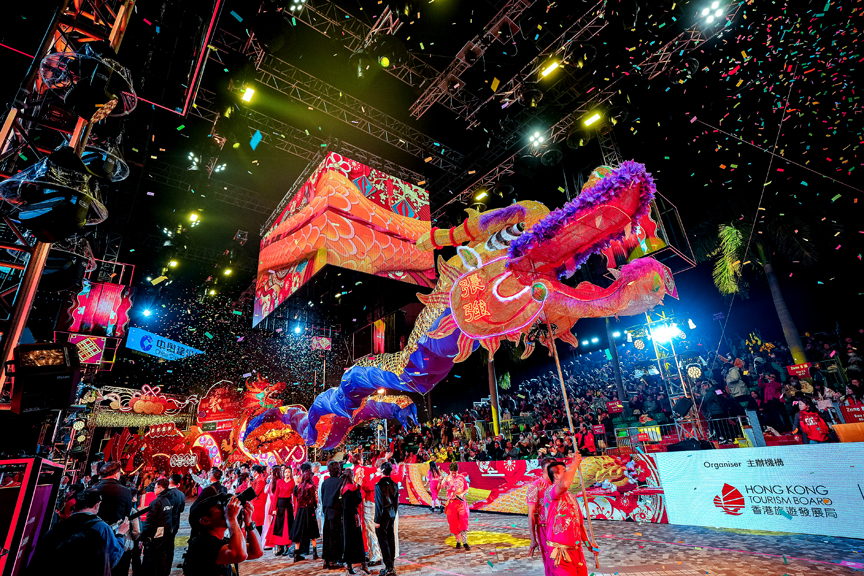
The “International Chinese New Year Night Parade” on the first day of the new year is the grand highlight of Hong Kong’s festivities. Vibrant themed floats glide through Tsim Sha Tsui, accompanied by performance groups from around the world dancing and singing in celebration. The fusion of tradition and global culture creates a dazzling spectacle that draws immense crowds and offers countless photo-worthy moments. Another highlight is the Lunar New Year Fireworks Show on the evening of the second day of the Lunar New Year, when dazzling fireworks illuminate Victoria Harbour’s nightscape in a truly captivating display.

Throughout the first lunar month, Che Kung Temple is as popular and bustling as Wong Tai Sin. The second day of the lunar year coincides with Che Kung’s Birthday, when many head to the temple to pray for peace and good fortune. Inside stands an impressive statue of Che Kung, alongside a copper windmill shaped like a fan blade—believed to bring good luck when spun clockwise. Visitors may also purchase smaller windmills to take blessings home. Traditionally, the third day of the new year is considered Chikou (Red Mouth Day), a day prone to quarrels, prompting many to visit the temple instead of paying social calls. Compared with the third day, the temple is usually slightly less crowded on the second.

Hong Kong’s horse racing culture is world-renowned, and the annual Lunar New Year race day on the third day of the new year is a major citywide highlight. The event draws vast crowds of racing fans and families, creating an electrifying atmosphere. Trying your luck on a few races is said to set the tone for a prosperous year. Sha Tin Racecourse also hosts special festive programmes and live performances. Wearing red is believed to bring good luck—and some even joke that if you win repeatedly, avoid washing your hands so you don’t “wash away” your luck.

Every Lunar New Year, the wishing trees in Lam Tsuen, Tai Po, draw large numbers of visitors. Between the first day and the fifteenth day of the New Year, the tradition of throwing Baodie (Blessing Certificate) is at its most lively. Visitors write their wishes on a paper tied to an orange, offer a prayer, and toss it toward the tree. If it lands securely, the wish is believed to come true; the higher it hangs, the more likely it is to be fulfilled. In recent years, to protect the original trees, the ritual now takes place using replicas and specially designed wish-throwing installations, though the festive charm remains just as strong.

Lunar New Year in Hong Kong is not only a celebration of tradition; it is also infused with the energy and vibrancy of a modern metropolis. From the parade to the racecourse, from flower markets to temple blessings, every event radiates joy and positivity. Visiting Hong Kong during this season—whether with family, friends, or children—offers the perfect opportunity to embrace good fortune and experience the city’s uniquely rich festive spirit as tradition and modernity intertwine. Want to discover even more of what Hong Kong offers? Visit the Hong Kong Tourism Board’s one-stop deals platform for exclusive offers and unforgettable experiences across the city: https://www.discoverhongkong.com/ca