
Story | Connie Li Photography | Featured Hotels
What makes New Zealand distinctive is not an abundance of curated experiences, but a landscape that refuses to be rushed. Mountains, rivers, coastlines and open farmland move at their own pace, shaped by light, wind, and water rather than schedules.
Step away from the city, breathing deepens, movement slows—the body adjusts almost immediately. Attention returns to the ground underfoot, the horizon ahead, and the quiet rhythm of day and night—something not learned, but remembered.
Across the country, a small number of estate-style retreats are designed to follow this natural logic. Each setting elicits a different response: listening, observing, focusing inward, recalibrating movement, or releasing accumulated tension.
LISTENING TO WATER: A RIVER MOVING THROUGH TIME
Downstream from Lake Taupo, on the volcanic plateau of New Zealand’s North Island, the Waikato River widens and settles into a steady flow. Here, the water no longer announces itself as spectacle, but moves forward at a nearconstant pace, its sound low and continuous. Standing along the riverbank, breathing instinctively slows, guided not by intention but by rhythm.


Mature forest lines the water’s edge, filtering sunlight into softened fragments. Footpaths are uneven, requiring attention to subtle changes in ground and moisture. This gentle unpredictability draws focus away from thought and back into the present moment, allowing the nervous system to gradually ease.


Huka Lodge is discreetly embedded within this riverside landscape. Its lowslung buildings are spread among trees and along the water, never competing for attention. Even indoors, the presence of the river—its sound, shifting light, and ambient temperature—is unmistakable. The lodge functions less as a destination than as a place of sustained immersion in the river’s calm, unbroken tempo.
SEEKING LIGHT: THE MOVEMENT OF A VALLEY
The Ahuriri Valley lies deep in New Zealand’s South Island interior, between the Southern Alps and the Mackenzie Basin. The land is open and sparsely vegetated, shaped by gentle rises and long horizons. What defines the landscape most distinctly is not a single view, but the movement of light itself.
Morning sunlight slowly climbs the valley floor. By afternoon, shadows stretch and shift along the contours of the hills. As evening approaches, the land is gradually enveloped in soft, muted tones. With no urban light sources to interrupt the cycle, the body becomes acutely aware of time passing with alertness, hunger, and rest returning to a natural sequence.

The architecture of The Lindis follows the land closely, extending along the terrain with rooflines that echo the valley’s contours. From a distance, the structures appear almost geological. Freestanding pods are positioned to ensure visual isolation, allowing long periods of uninterrupted solitude. The lodge’s minimal presence leaves guests fully exposed to the rhythms of light and landscape.
WATCHING THE LAKE: ENCLOSED BY WATER AND MOUNTAINS
Lake Wakatipu lies in the southwestern reaches of the South Island, near Queenstown, its waters encircled by the Humboldt Mountains. The peaks rise in a continuous wall, creating a sense of enclosure that separates the lake from the outside world. Sound is absorbed by distance and terrain, leaving only the low murmur of wind across the water.
Within this natural enclosure, the senses begin to draw inward. The view no longer seeks expansion but is gently framed by water and rock. Thoughts quiet, perception sharpens, and attention settles.

Blanket Bay Lodge occupies a quiet stretch of shoreline, its scale deliberately restrained. Rooms face the lake without turning the view into spectacle. The lodge serves simply as a place to remain—allowing the surrounding mountains and water to do the work of holding one’s focus steady.
REACHING THE CLIFFS: WHERE SPACE RELEASES TENSION
Off the east coast of the North Island, Cape Kidnappers rises sharply above the Pacific ocean. Cliffs plunge directly into the sea, exposed to strong winds and an uninterrupted horizon. Standing at the edge, the scale of space reasserts itself—tightness loosens, and the mind recalibrates against the vastness ahead.
Walking along the cliff edges demands attention. Shifting ground and wind direction discourage distraction and make haste impossible. Movement becomes deliberate.

The buildings of Rosewood Cape Kidnappers extend along the cliffs in low, horizontal lines that yield to the landscape rather than challenge it. The lodge acts as a vantage point—one that allows guests to remain within this open, expansive state long enough for emotional tension to gradually dissolve.
FACING THE WIND: GRASSLAND AND OPEN COAST
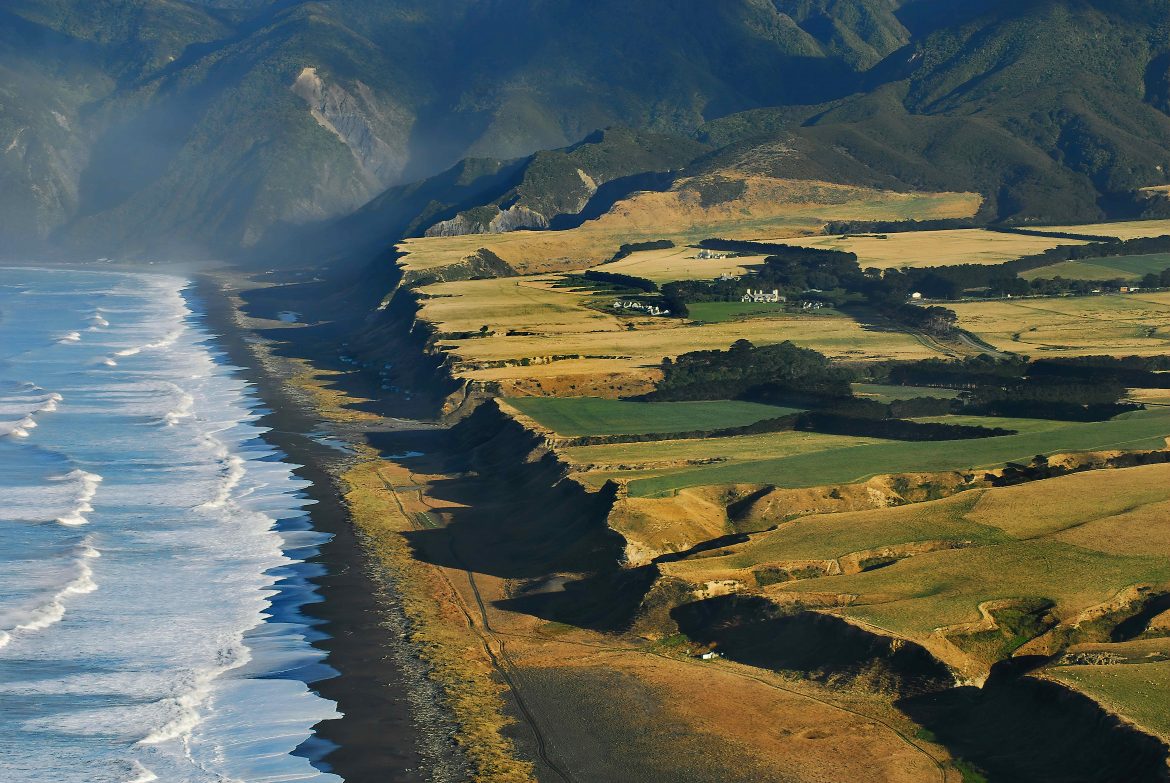
At the southern tip of the North Island, Palliser Bay opens directly onto the Cook Strait. The coastline is broad and exposed, shaped by persistent winds that move uninterrupted across open grassland. There is little artifice here—only enduring elements: wind, salt, distance, and land.

Movement in this environment cannot be hurried. Reaching any destination requires physically crossing ground, step by step. Over time, the body adapts to a steady, low-intensity rhythm of motion.

Wharekauhau Country Estate reflects the scale of a traditional farmstead. Individual cottages are scattered across the terrain, blurring the boundary between indoors and out. Wind, sound, and scent are ever-present. Daily life unfolds within natural conditions, gradually restoring a grounded relationship between body, movement, and environment.
Surrounded by water, wind, open land and sky, our internal clock resets in New Zealand—without instruction, without effort.
