
From unspoiled landscapes to a people rich in culture and customs, New Zealand’s central North Island is also where geothermal activity and highly sought-after M nuka honey is found.
I might be some 230 kilometres southeast of Auckland, in the Bay of Plenty Region on the North Island, but this smell—permeating and unwavering—wraps itself snuggly, like a thick cloak, around me.

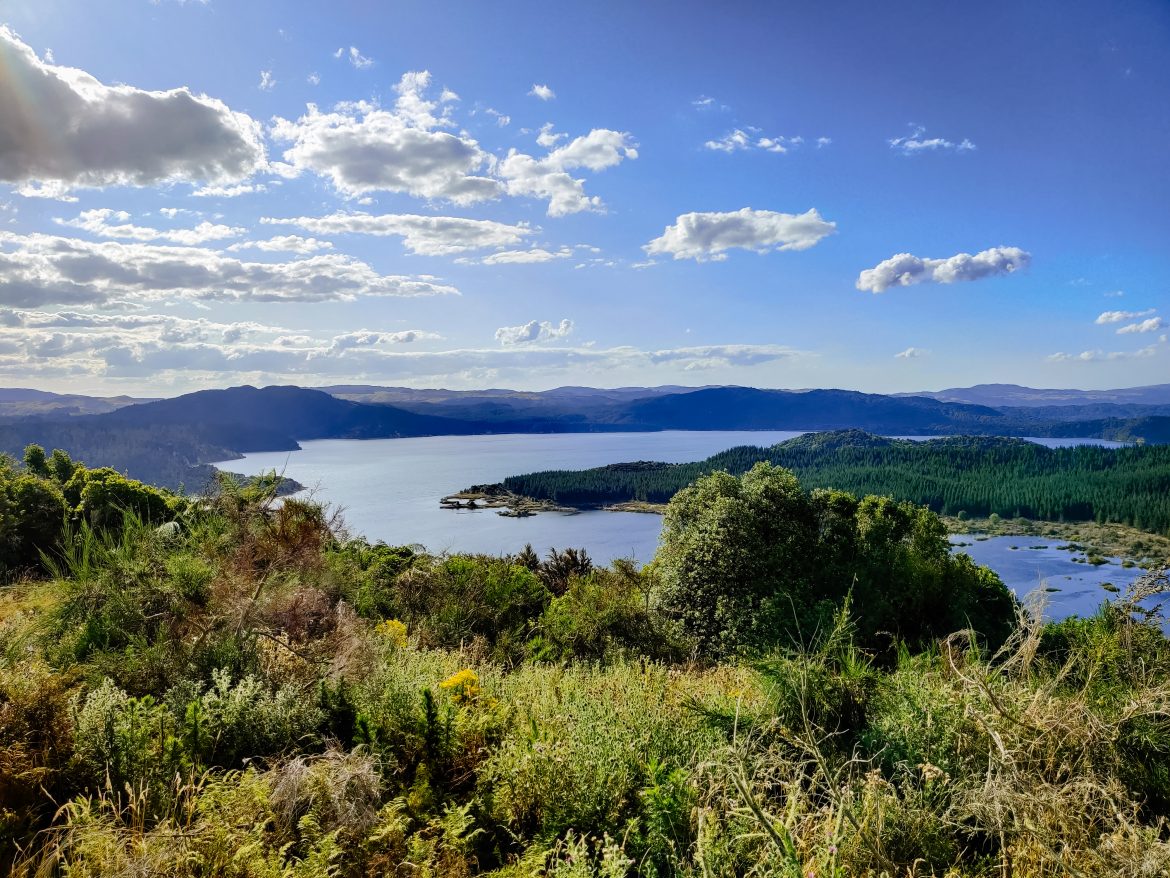
Panoramic views of Waimangu from above.
There’s a reason why Rotorua’s nickname is Sulphur City. Named after Lake Rotorua, the city is known for its geothermal activity and pungent smell. The latter is due to hydrogen sulphide emissions, which have the unappealing aroma of rotten eggs.
If the wispy plumes of steam rising off bubbling thermal pools and geysers found near Lake Rotorua weren’t enough of a warning, then surely the clear, reflective acidic aqua lakes would deter hydrophiles from toe dipping. A friend who had travelled through the region once told me her clothes still reeked of sulphur for six months, despite weekly washings.

Onuku M ori Land Trust trustee Ken Raureti shares the history and cultural significance of Mount Tarawera. This crater was created from the devastating eruption in 1886, which destroyed the famed Pink and White Terraces, plus covered the surrounding area with volcanic ash, mud and debris about 20 metres deep.
A spa and resort town since the 1800s, Rotorua is also home to botanical gardens, historic architecture and more than 130 kilometres of world-famous mountain biking trails. Experience the richness of M ori traditions and culture by taking a journey to Tamaki M ori Village, one of TripAdvisor’s top seven experiences in the world. Understand how the M ori protect their m tauranga (pre-European knowledge) through the haka and other art forms before feasting on a traditional geothermal hangi.
Sheltered under the canopy of magnificent Tawa trees, I learn the practice of kaitiakitanga—the kinship between humans and nature, manifested through environmental stewardship. The latter is related to the reason I’m here: to learn more about M nuka honey, the land it comes from and the people who harvest the liquid gold.

An early-morning capture of Lake Rotorua and the steam rising from still-active geysers and hot mud pools.
From the peak of Mount Ngongotah , I met the trustees of Onuku M ori Land Trust, including chairperson Moyra Te Ariki Bramley. We’re dining on a freshly prepared array of New Zealand’s prized fare—locally-sourced meats, including lamb and beef, to plump mussels, fruit and airy pavlova, and my new favourite, gold k mara (sweet potato)—at Skyline Rotorua’s Stratosfare, while enjoying a panoramic view of Lake Rotorua.
I learn about the successful farming and forestry operations the Trust has developed on the volcanically active landscape since 1982, including the administration and farming of about 25 square kilometres of land that was
devastated by the 1886 eruption of Mount Tarawera, just outside Rotorua.

Have an immersive experience at Tamaki M ori Village, learning the haka and feasting on a traditional geothermal hangi.
They’re also associated with the management of lands for Onuku Limited. The latter, a 100-per-cent M ori owned company headed by trustee and shareholder Les Stowell, is best known internationally for partnering
with local M ori people to source, harvest and distribute the highest quality of M nuka honey available. The brand is known for its provenance, allowing product traceability through ApiTrak, which permits direct end-user product authentication.
While beekeeping has always been part of M ori life, honey harvesting has exploded in the past decade as interest in, and value of, M nuka honey grew. Prized for its antibacterial, anti-inflammatory and antioxidant properties, the nectar is produced from flowers of the M nuka bush flowers, which are indigenous to New Zealand.

The lookout, built by the Onuku M ori Land Trust above Waimangu, is marked by Pou, with two-dimensional faces that watch over 360 degrees of the Trust’s whenua (land). Pou are carved wooden posts used by M ori to mark places of significance and represent all the people who lived in the area.
I learn, however, that M nuka flowers only bloom for two to six weeks of the year, during which only 10-thousand tonnes of honey are harvested. That means there is a limited supply at any given time, and honeys
produced elsewhere claiming to be M nuka, or are adulterated from being blended with other non-M nuka honeys, are considered counterfeit.
To ensure authenticity, consumers have to look for the official Unique M nuka Factor (UMF) grade, where quality is directly related to the rating. Of note, honeys that are UMF15+ are used as topical medicines and provide other immune system benefits, while lower grades are best for eating or integrated into products, like soaps by Tarnz Cosmetics in Waihua Bay.

Mori beekeeper Angelas Tahere pulls out a honey frame where worker bees surround the hive’s queen (that’s marked with a bright green dot), uncapping the wax off a portion of the frame to sample fresh M nuka honey.
Stowell takes us on a private tour of parcels of Onuku lands where the honey is harvested. In contrast to the cityscapes I’m used to, the undulating and lush landscapes seem to incite deeper breaths and a release of tension. I feel instantly refreshed and rejuvenated, invested in being one with nature. Surrounded by Pous from a lookout in Boundary Road farm, we gaze at the vastness around us, then down at Waimangu, the world’s youngest geothermal valley.
Later on a self-guided tour of Waimangu Volcanic Valley, I’m greeted with jaw-dropping vistas. I gasp at Emerald Lake, with its mats of algae and sphagnum moss, that is wrapped in regenerating native forest. There’s panoramic views of the world’s largest hot spring, Frying Pan Lake, within Echo Crater that’s a balmy 55°C and bubbling with highly acidic hydrogen sulphide gas. I continue to walk along trails lined with colourful mineral or gleaming silica deposited by creeks and springs until I reach Inferno Crater Lake.

Waimangu’s Inferno Crater Lake is a pale blue gem that’s the result of the 1886 eruption of Mount Tarawera. In addition to the lake’s levels rising and falling in cycles, the water is an unassuming 35 to 80°C, with acidity up to pH 2.2.
Lost in the glow of its crystal clear aqua waters, I’m almost impervious to the hidden danger: here, fumaroles—not wisps of angel mist—emerge from the near boiling, highly acidic lake’s surface. Then it’s a boat cruise around Lake Rotomahana to spy on steaming cliffs and geysers along the southwest shoreline, and to catch glimpses of where the legendary Pink and White Terraces, considered the eighth wonder of the world, were once visible.
Captivated by all this beauty, a daunting reality hits me. Despite the size of the island country, there’s an unshakable force that can erupt at any moment beneath its surface. It can be likened to the highly potent nectar collected from the M nuka bush that can be used to heal and nourish. Mother Nature is both marvellous and powerful.

See vibrant colours of microbe-covered hot rocks, geysers and hot springs, mineral deposits and lush native forests on a self-guided walk along one of Waimangu Volcanic Valley’s trails.
Volcanic sounds
Although travel to New Zealand is on hold at press time, you can transport yourself to the North and South Islands through an auditory journey. The country has launched a Spotify channel with sounds from the islands,
including native birds, bubbling geothermal mud pools and the gentle sound of the breeze moving through the forest.
Under the artist name 100% Pure New Zealand, the album Mindful Journeys features four meditative audio tracks (two with narration and two without) to help calm the mind and disconnect from the world for a few moments. Tune into North Island—Far North to Rotorua to hear the sounds from the geothermal area of Rotorua—steaming water, bubbling mud pools and the distinctive rush of the natural geysers.
How to get there
Air New Zealand (airline partner of Air Canada) flies to Auckland from Toronto and Vancouver. From there you can drive, bus or fly to Rotorua via regional airlines, such as Air Chathams.
Where to stay
I stayed at the centrally-located Millennium Hotel, an internationalclass hotel that offers air-conditioned rooms with heating utilizing natural geothermal resources. Besides having a spa, a heated swimming pool,
gym and various dining options, those with Club Floor rooms have complimentary access to the exclusive Club Lounge and its services.
What to do
From Hobbiton Movie Set, recognized by fans of The Lord of the Rings and The Hobbit, to rolling around in an outdoor gravity orb, white water rafting to a guided experience along the ridge of Mount Tarawera’s crater, there’s plenty to do when it comes to outdoor adventures in and around the area. There are also mineral springs and a range of hot pools for bathing, plus geysers, terraces and other natural formations to visit. A diverse collection of contemporary and international restaurants and bars can be found in Rotorua’s CBD or at Eat Street that dominates the lake end of Tutanekai Street.
