
Story | Leslie Yip Boucher-Harris Photography | Fendi & Cher Bai
Earlier this year, I was invited to step into a world few are privileged to experience—The World of FENDI, an invitation-only celebration of the Maison’s 100th anniversary. Set in an impeccably styled private residence in Miami’s Bayshore area, the event felt less like a fashion showcase and more like entering a living archive of Italian artistry, family legacy and avant-garde luxury.

While FENDI has long been synonymous with exquisite craftsmanship, seeing it unfold in such an intimate, immersive way was a revelation. This wasn’t merely about browsing products – this was couture-level personalization, guided by artisans and designers flown in from Rome. The house, transformed into an atelier-meets-museum, invited its most loyal clients to create one-of-a-kind treasures—custom bags, fur pieces and even high jewellery—crafted on the spot.


The Art of the Bag: Design without Limits
The centre of the experience was a grand, oversized round table anchoring the room. Around it, clients and artisans collaborated like co-authors of future heirlooms. In front of each guest was a selection of fine leathers—sumptuous calfskins, crocodile in ten nuanced hues and exotics with finishes ranging from iridescent to Pequin stripes. The surrounding walls were lined with architect-style blueprint drawers, each brimming with metal bars, clasps and interchangeable handles— bamboo, crocodile, glittering alloys—ready to be configured.


Of particular note was the exclusive offering of interchangeable double-F clasps for the iconic Baguette bag. These were not your typical closures. The bespoke options included sculptural birds, flowers and Art Deco-inflected flourishes—an homage to FENDI’s 1925 founding at the height of the Art Deco era.


Once selections were finalized, the artisan team rendered digital mockups in real time, offering an immediate preview of the finished masterpiece. The customization at The World of FENDI is far beyond what’s available in boutiques. At stores, you choose from curated selections. here, you cocreate something that exists only once—it’s uniquely yours.


And when your one-of-a-kind bag is finally ready, it arrives in a special eggshell-white box—reserved only for World of FENDI commissions, rather than the Maison’s signature yellow. Even the dust bag comes personalized. The finishing touch? A handwritten note from Silvia Venturini Fendi herself: “Enjoy Your Bag.” how special is that?
A Century of Bags, Reimagined
To honour their 100-year legacy, FENDI revisited and reinterpreted one iconic bag from each decade, reworking them in canvas ivory Pergamena crocodile leather—a Maison signature. Among the most enchanting stories:
• The Adele (1925), the first FENDI handbag, was reborn with Selleria stitching on croc.

The Adele (1925), the first FENDI handbag.


• The La Pasta bag (1985–1995), inspired by Karl Lagerfeld’s stroll through a Roman grocer, embodied whimsy and culinary homage.

• Of course, the Baguette (1995–2005), now available in millions of customizable permutations, stood as a pillar of fashionable self-expression. Each archival silhouette carried echoes of its era, yet felt utterly modern in execution.

1995-2005
Each archival silhouette carried echoes of its era, yet felt utterly modern in execution.
FENDI: Born in Fur, Reborn in Innovation
It’s easy to forget that FENDI began not in handbags, but in fur. Established in 1925 as a fur and leather shop in Rome, the Maison has continually reinvented how fur is perceived and worn. upstairs at the event, this legacy was on full display with a curated collection of fur samples, showcasing both archival techniques and futuristic experimentation.


From the sporty Colour Pequin beaver bomber of 1967, symbolizing the liberating energy of the ‘60s, to the avant-garde Interlace of 2016—a featherlight weave of leather and mink nicknamed “air conditioner fur” by Lagerfeld—each piece pushed the boundaries of what fur could be.


 There was even a technique I mistook for denim. only upon touch did I realize it was crafted from fine rows of sheared fur. The illusion was f lawless, and the sensation luxurious. other high-fur options included chinchilla, Swakara and bobcat—many adorned with botanical inlays, lace motifs or geometric crafts.


What stood out was the respect for both tradition and evolution. FENDI doesn’t just remake furs—it redefines them. The Made-To-order collection offered here allowed clients to shape their own vision, blending historical techniques like Gheronato and Lavorazione 28 with modern silhouettes and textures.
The Pinnacle: Radici Romane high Jewellery
If the leather and fur rooms were workshops of tactile pleasure, the upstairs salon was a sanctuary of pure enchantment. Presented as part of the 100th anniversary, the Radici Romane high Jewellery Collection, designed by Delfina Delettrez Fendi, celebrated heritage through a poetic lens.
 Inspired by Rome’s architectural grandeur and natural beauty, the collection fused lyrical sophistication with sculptural forms. Delfina’s jewels defy gravity and expectation—pieces appear to float, stones set at improbable angles in deeply hued settings.

The emotional crescendo came with Les Cinq Doigts d’une Main, five statement rings symbolizing the five original Fendi sisters. Their forms were drawn from a 1974 sketch by Karl Lagerfeld, immortalizing not just family, but feminine force.
FENDI, Then and Now


One whimsical yet meaningful motif stood out for FENDI’s centenary celebration: the squirrel. It wasn’t just charming —it was personal. One of the founding Fendi sisters had been affectionately nicknamed “the busy squirrel” by her husband, and the motif now stands as a tribute woven into the Centenary celebration.

To understand the impact of The World of FENDI has to grasp what the brand has always stood for: family, craftsmanship, daring creativity and unrelenting innovation. Founded by Adele and Edoardo Fendi in Rome, the company would later be led by their five daughters, each leaving her mark on the brand. With the arrival of Karl Lagerfeld in 1965, FENDI became a powerhouse of reinvention, blending modernity with Roman refinement.


Today, under the stewardship of Silvia Venturini Fendi and a new generation of visionaries, the brand retains that balance of intimacy and boldness. This centenary event is not simply a celebration; it’s a reaffirmation of the values that have defined FENDI for a century and a promise of what’s to come.
A Global Tribute
The World of FENDI 2025 tour continues through November, with stops in Seoul, Suzhou, Rome and other cities where the Maison’s most loyal patrons are invited to co-create, reflect and celebrate. Each destination honours the past while looking toward the future— embodying FENDI’s ethos of elegance with edge.

 In a world of fast fashion and fleeting trends, The World of FENDI offers something far more enduring: a chance to be part of history, to place your fingerprint on the legacy of a house that has never stopped innovating and never stopped caring.

As evening fell and I stepped out into the balmy Miami air, I noticed something unexpected by the front door: a basketball hoop and a cage full of FENDI-branded basketballs. Elegant guests in linen and heels took playful shots between champagne sips, laughing under the string lights. It was a reminder that even a century-old fashion house can still surprise you with a wink—and a perfect three-pointer.

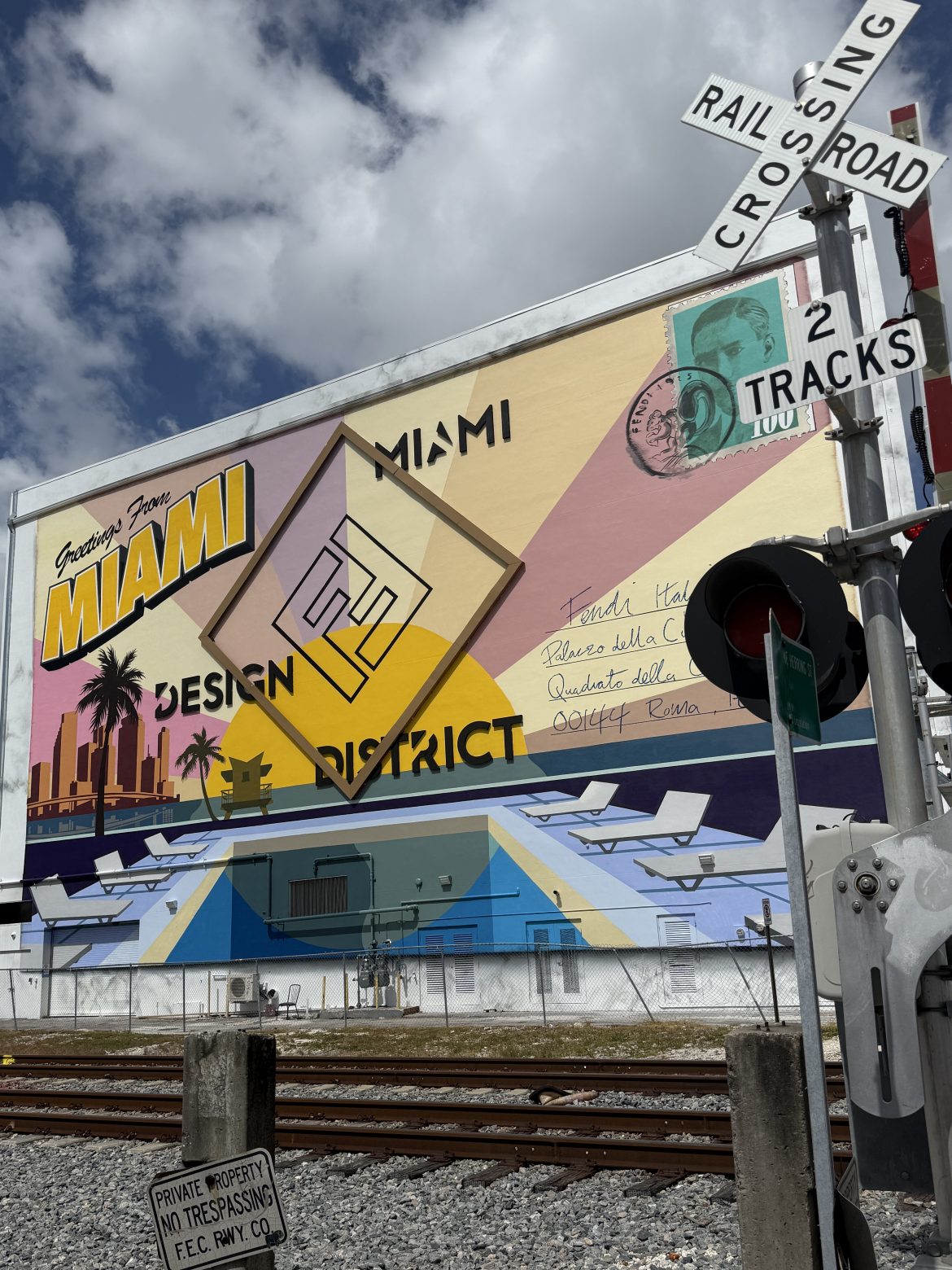
Issued by the Italian Post Office to commemorate FENDI’s centenary, this collector’s stamp set features the Maison’s iconic yellow and the FF monogram created by Karl Lagerfeld in 1965. A must-have for fans, the limited-edition set includes envelopes, cards and a commemorative booklet—available online and at select post offices. It costs €2,90 for a single stamp, €4,50 for the first-day cover and €130,50 for the booklet.


